The local story
Before Audrey Moore was the name on a recreation center, she was an Annandale resident learning how to fight for a park. That history matters now, as Fairfax County prepares to replace the building inside the very place she helped protect.
The project at 8100 Braddock Road would replace the entire rec center, not demolish Wakefield Park. A new building would bring separate competition and warm-water pools, larger fitness and program spaces, childcare and an expanded senior center. For the people who use Audrey Moore every week, it also means planning for a long interruption.
As checked October 31, 2026, the center is not closed for this project now. The county anticipates closure in late spring 2028 and reopening in late spring 2031. The November 3 vote concerns countywide parks borrowing that would help fund the project; the decision to replace the building was approved in 2024. Here is how the history, the drawings and the money fit together.
Start here
One familiar address. Three different decisions.
“They’re tearing down Audrey Moore” leaves out the most useful information: what is being replaced, when it happens and what voters are actually being asked to approve. The building, the park and the bond are connected, but they have different timelines.
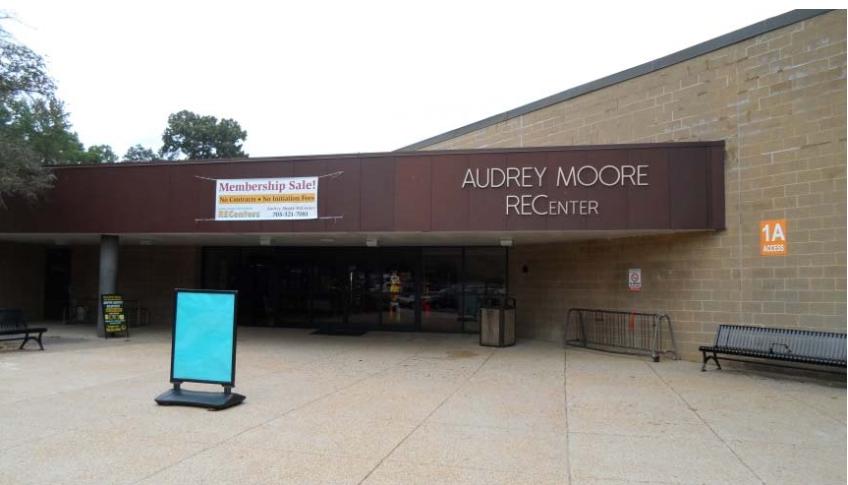
Wakefield’s rec center opened in 1977, the first built by the Fairfax County Park Authority. Nearly half a century later, the proposed replacement would keep a major public recreation destination at this Annandale address. The next step is financing and continued design, rather than an immediate shutdown.
The building people know
The woman behind the name
Audrey Moore learned the rules, then challenged the plans.
Audrey Elizabeth Moore came to Annandale in 1956, when suburban growth was rapidly changing Fairfax County. Born in Venezuela and raised in New York, she had moved to Washington for work before settling here. The Virginia General Assembly’s memorial describes a resident who taught herself planning, rezoning and the laws governing sewers, transportation and parks. Those technical subjects became tools for protecting the place where she lived.
Her route into public life began in neighborhood civic work. In 1966, she led a door-to-door campaign to save Wakefield Park and helped advance an $18 million effort to expand parks across Fairfax County. The larger point is easy to miss when her name appears on a swimming schedule: the recreation center honors someone who organized around land and public decisions long before it became a familiar community building.
Moore went on to represent the Annandale District, now called Braddock, on the Board of Supervisors for four terms, then served as countywide chairman from 1988 through 1991. Her concerns reached beyond Wakefield. She supported restrictions on development in the Occoquan Basin, connecting the county’s growth decisions with protection of its water supply.
She died on December 12, 2018. Her public legacy is especially tangible here: a place people can enter, use and return to, rather than a name preserved only in a list of former officeholders.
Audrey Moore

The fight for Wakefield
A park first. A recreation center later.
In her 2005 oral history, Moore recalled learning that high-rises were planned for the Webb–Wood tract, woods her children loved to walk. She imagined connected parkland along Accotink Creek instead. Calls to civic associations grew into a coalition of neighborhoods with their own open-space needs. The campaign also pushed a once-reluctant speaker to stand up in public and argue for park money.
There is a revealing wrinkle in the story. Moore recalled wanting the county to buy more parkland before spending on a recreation center. Her concern was timing: land could be lost to development while a building could come later. That distinction keeps the history honest. Saving a park and agreeing with every later spending choice inside it were not the same position.
When Wakefield’s recreation center reached its 25th anniversary, the county gave it her name. Board of Supervisors records identify May 4, 2002, as the renaming celebration and explicitly connect the honor to her successful efforts to preserve Wakefield Park. In the oral history, she called the naming “one of the nicest things that ever happened.”
That makes the current replacement more interesting than a simple old-building/new-building story. The park survived a debate over how public land should be used; the center now faces a debate over how public facilities should serve another generation. Moore’s words explain why the first question matters, without telling us how she would have voted on a project proposed years after her death.
Why replace it?
The problems extend beyond an aging appearance.
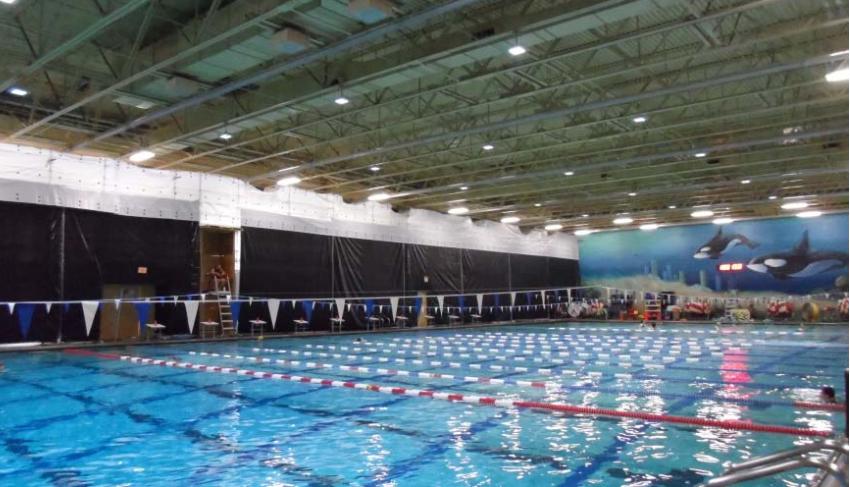
A pool or gym can remain deeply useful while the building around it becomes harder to operate. The county reports more than 333,000 visits to Audrey Moore in the previous year, a measure of repeat use rather than 333,000 different people. Its case for replacement combines that demand with cramped fitness space, entrance bottlenecks, accessibility issues, limited programming rooms and only one family changing room.
The machinery tells another part of the story. The March 2026 staff briefing identifies aging electrical equipment, pool ventilation, filtration and boilers. It also documents emergency repairs to corroded pool-hall columns, completed in September 2025. Those are reasons for long-term capital work, not evidence that the center is currently closed or that visitors should infer an unannounced emergency.
The Park Authority Board approved full demolition and replacement on October 23, 2024. Staff cited lessons from the Mount Vernon Rec Center project in recommending a fresh building instead of working around the old structure. The county describes that approach as offering greater predictability for construction timing and cost. Predictability is the goal; the published schedule is still an estimate.
Community input also preceded the latest drawings. A DLR Group survey report dated January 21, 2022, analyzed 2,915 usable responses from an open survey. Comments raised practical needs such as easier pool entry, better changing spaces and different water temperatures for different activities. It was voluntary feedback, not a representative poll of everyone in Annandale.
The pool inside the existing center
Read the drawings
Two pools, more everyday space and a different arrival.
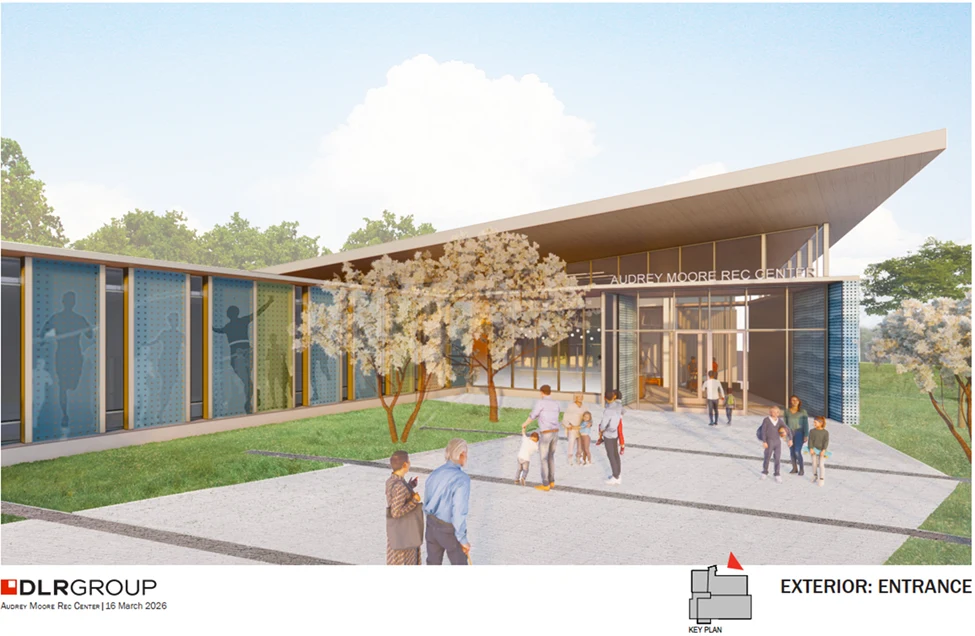
The official concept images are useful because they show relationships: where people arrive, how rooms sit beside one another and how the recreation center connects to its surroundings. They are proposed designs, not construction photographs or a final promise about every wall, finish or piece of equipment.
The concept organizes activities across two levels and gives the approach to the building its own gathering space. Reading these views together is more revealing than judging a single exterior: the entrance, circulation and quieter program rooms matter as much as the biggest athletic spaces.
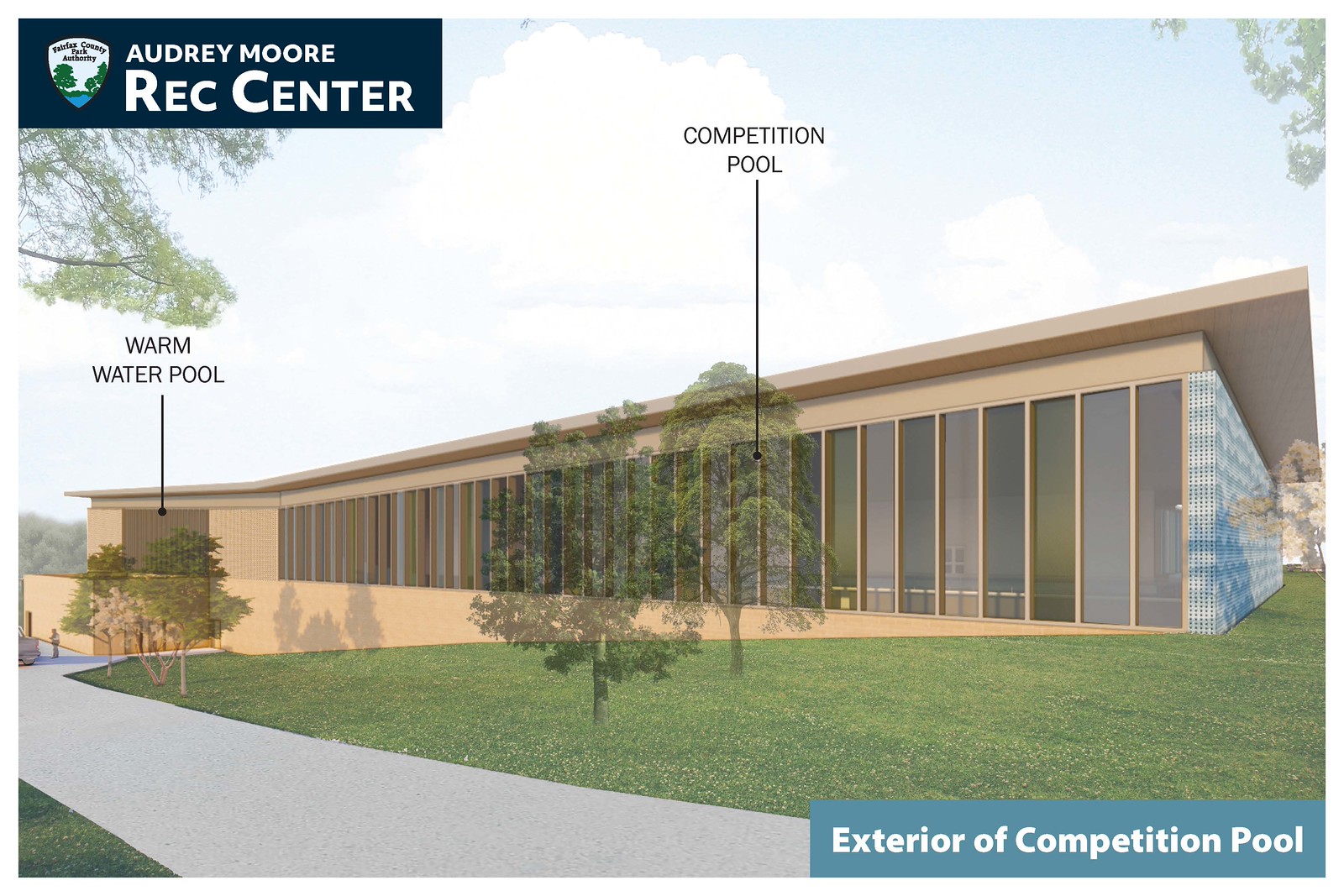
A competition pool and a warmer pool serve different needs
The proposal pairs an Olympic-size competition pool with a separate warm-water pool intended for children, older adults and people with disabilities. That separation addresses one of the existing center’s recurring conflicts: the water temperature and layout that work for lap swimming do not necessarily fit beginner lessons or other aquatic programs.
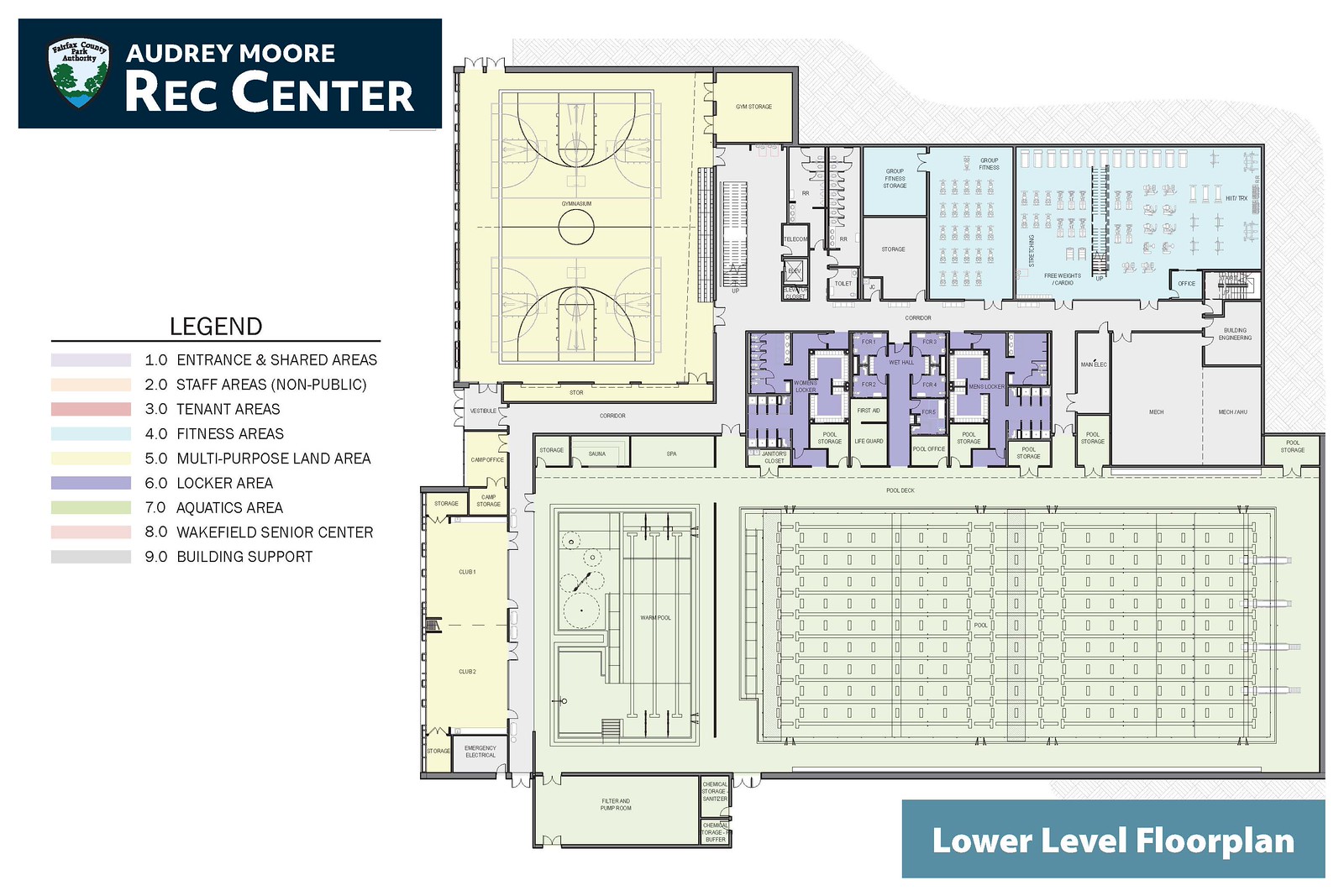
The aquatic concept labels zero-depth entry and accessible ramps. The lower-level drawing shows the pools as distinct spaces alongside their support areas. Look at those connections, not just the size of the pools on the plan. Changing, reaching the water and finding an appropriate program are all part of whether a pool works for a particular household.
How the two pool spaces would sit together
Read the lower-level plan
Fitness, classes, childcare and the senior center
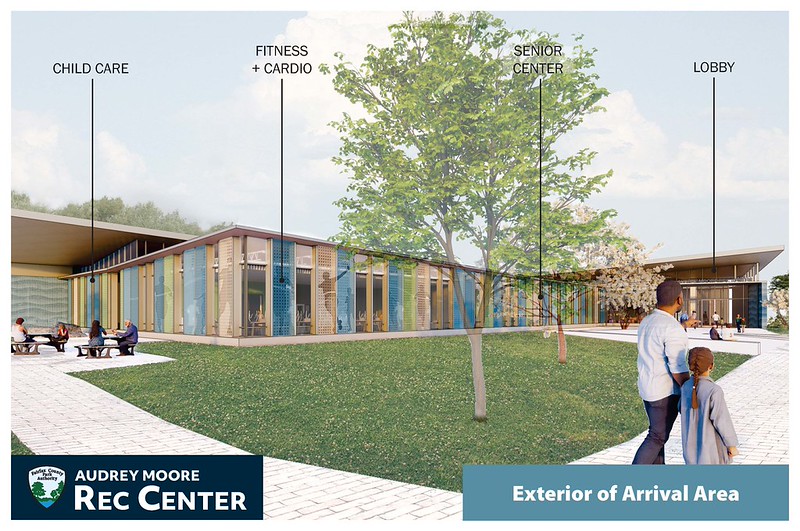
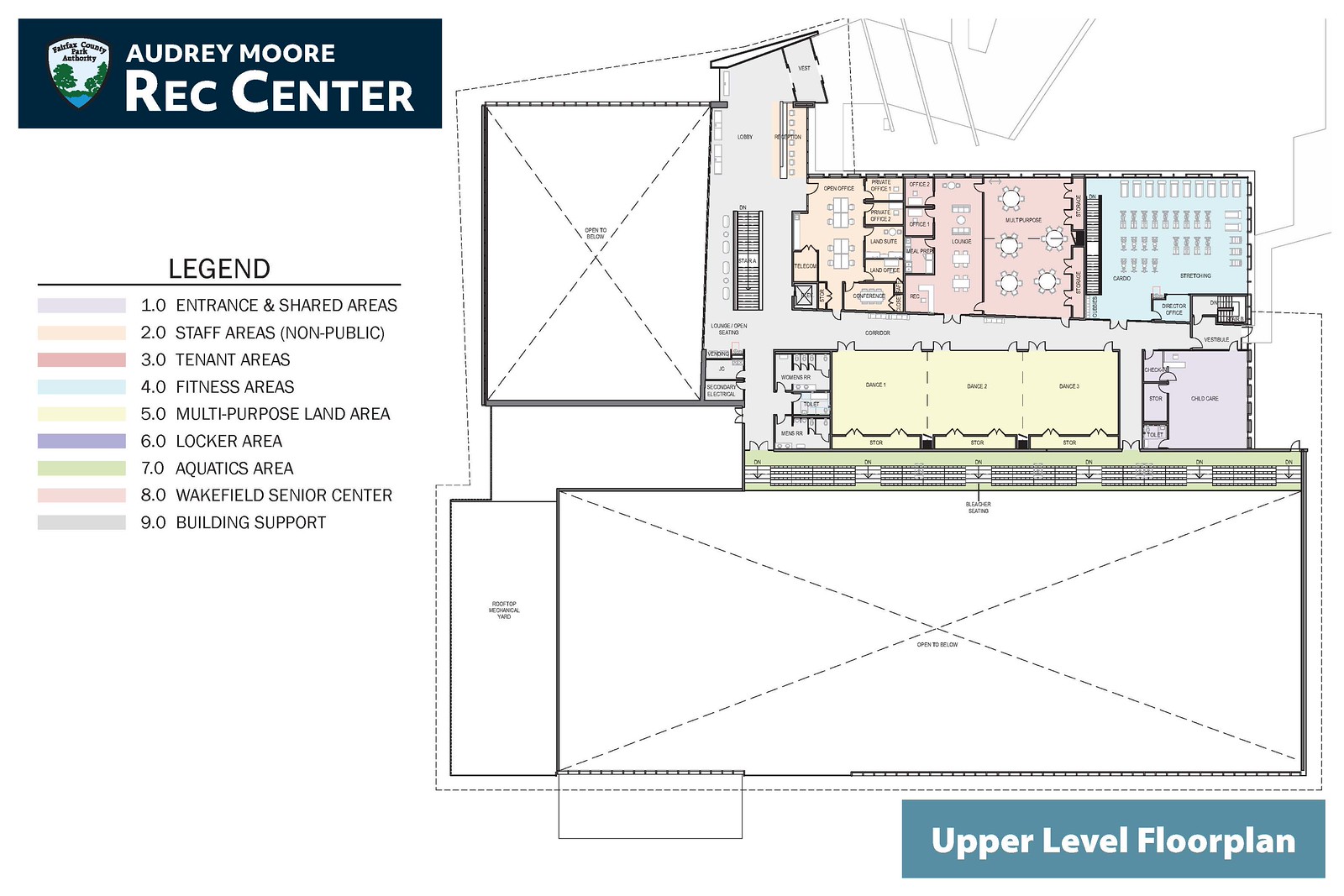
Expanded fitness and programming areas, childcare and a larger senior center are all in the announced scope. Neighborhood and Community Services is the county partner for the senior-center component. The arrival rendering labels these uses around the entrance, while the upper-level plan shows how lobby, senior-center rooms, childcare, cardio and dance spaces would connect.
Those drawings are a useful starting point for questions about access and daily operations. A parent may want to know how childcare will work alongside a class. A senior-center participant may care most about the entrance, drop-off and route to a program room. Hours, staffing, future fees and registration rules will require operational information beyond an architectural rendering.
A proposed arrival space
Read the upper-level plan
The building belongs to a larger park
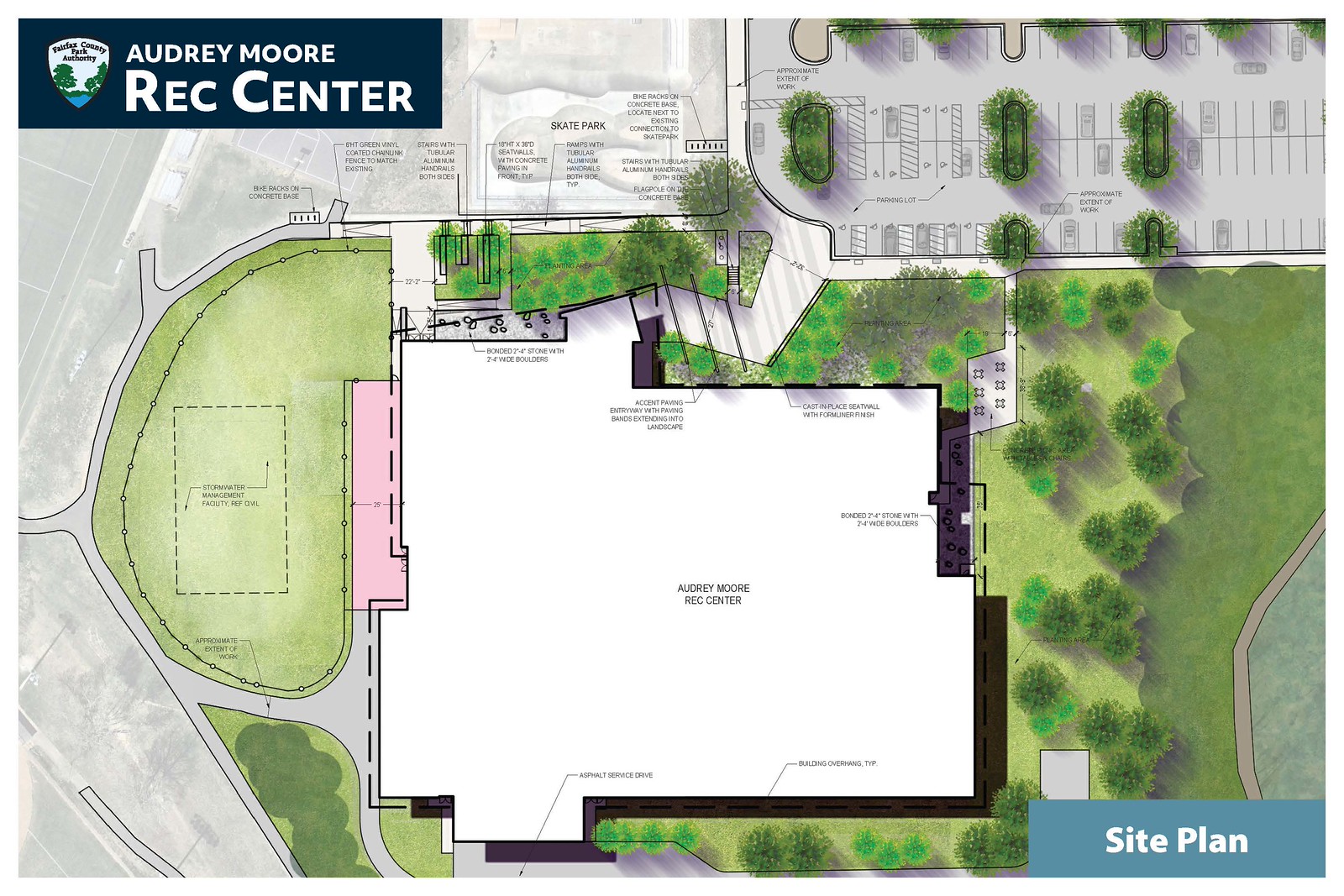
The landscape plan places the proposed center among parking, paths and Wakefield’s outdoor recreation spaces. It helps explain why a replacement building does not mean the whole park is being cleared. It is a design illustration, however, not a construction-stage access map.
The March briefing sets universal design and at least LEED Silver as goals. Those are standards the project is working toward, not a certification already earned. The important test will be the finished experience: whether people of different ages and abilities can comfortably arrive, move through the building and use it.
Where the replacement would meet the park
The November 3 vote
Three money figures that should not be mixed together.
Fairfax County voters will see a “Fairfax County Parks and Park Facilities” bond question on November 3, 2026. It asks whether the county may borrow up to $180 million for parks and park facilities across the system. Audrey Moore is a major proposed use of that funding, but the ballot question is broader than this one building.
The project’s own budget is $110 million. The March 2026 Park Authority briefing says the approved budget had increased from an earlier $85 million; a September 2026 county capital-project report also lists a $110 million total estimate. That is a project budget, not an awarded construction contract or proof that every needed dollar has been secured.
The $89 million number describes the entire rec-center category in the proposed bond. That category includes a new Audrey Moore plus deferred maintenance and concept plans for Franconia and Providence. The remaining proposed allocations are $51 million for deferred capital renovations, $19 million for new and existing parks, $12 million for natural and cultural resources and land acquisition, and $9 million for new amenities.
Earlier park bonds support design and permitting; the senior-center contribution and county capital assistance are also part of the funding picture. The November bond is another needed piece. A yes vote would authorize borrowing for the stated parks purposes. A no vote would withhold that proposed borrowing authority, leaving the funding plan to be revisited. Neither outcome, by itself, supplies a final construction schedule or approves each illustrated room.
The county’s plain-language explanation says specific project plans can change while bond proceeds remain limited to the purposes in the ballot question. Read that question separately from the other bond on the ballot, the $75 million Community Health and Human Services Facilities proposal. The two are distinct requests.
| Amount | What it describes |
|---|---|
| $110 million | Audrey Moore’s approved project budget / total estimate in 2026 county documents. Multiple funding sources are involved. |
| $89 million | The proposed bond’s whole rec-center category: Audrey Moore plus work associated with Franconia and Providence. |
| $180 million | The countywide parks and park facilities borrowing question on the November 3, 2026 ballot. |
The long calendar
A 2028 closure, with 2031 as the reopening target.
There is still substantial work between today’s concept and the first swim in a new pool. The county’s timetable leaves design and permitting ahead of construction. Its FAQ anticipates reopening in late spring 2031, while the schedule also places move-in and staff training in that window. Treat it as a planning target rather than a confirmed first day of classes.
County records are not fully aligned. An October 28, 2026 work-plan table lists construction from March 24, 2027, to October 24, 2030, earlier than the public FAQ’s 2028–2031 window. That table does not announce a revised visitor closure date. This guide uses the public FAQ for closure guidance and flags the discrepancy rather than presenting either schedule as guaranteed.
| Date | Milestone |
|---|---|
| 1966 | Audrey Moore leads a campaign to preserve Wakefield Park. |
| 1977 | Wakefield’s recreation center opens, the Park Authority’s first. |
| May 4, 2002 | 25th-anniversary celebration and renaming for Audrey Moore. |
| October 23, 2024 | Park Authority Board approves full demolition and replacement. |
| May–June 2026 | Public meeting held May 2; design comment period closes June 5. |
| November 3, 2026 | Countywide parks bond goes before voters; result not yet established. |
| Late 2026 | Next public design update listed in the county’s schedule. |
| Through spring 2028 | Design and permit approvals. |
| Late spring 2028 | Planned rec-center closure and construction start. |
| Late spring 2031 | Planned reopening window; move-in and staff training also scheduled. |
Plan your routine
What happens to swimming, pottery and the rest of the park?
For now, use the existing center’s visitor page, pool calendar and activity schedules. The address remains 8100 Braddock Road, Annandale, VA 22003; the center’s number is 703-321-7081, TTY 711. A future construction timetable should not replace a check of today’s operating hours or class availability.
During the planned closure, the county intends to relocate programs, including camps, where possible. Rec-center members already have access to all nine county centers, with Providence and South Run identified as the closest alternatives. Access to another building does not guarantee that a favorite instructor, class time or camp will transfer unchanged. Program-by-program relocation details will matter.
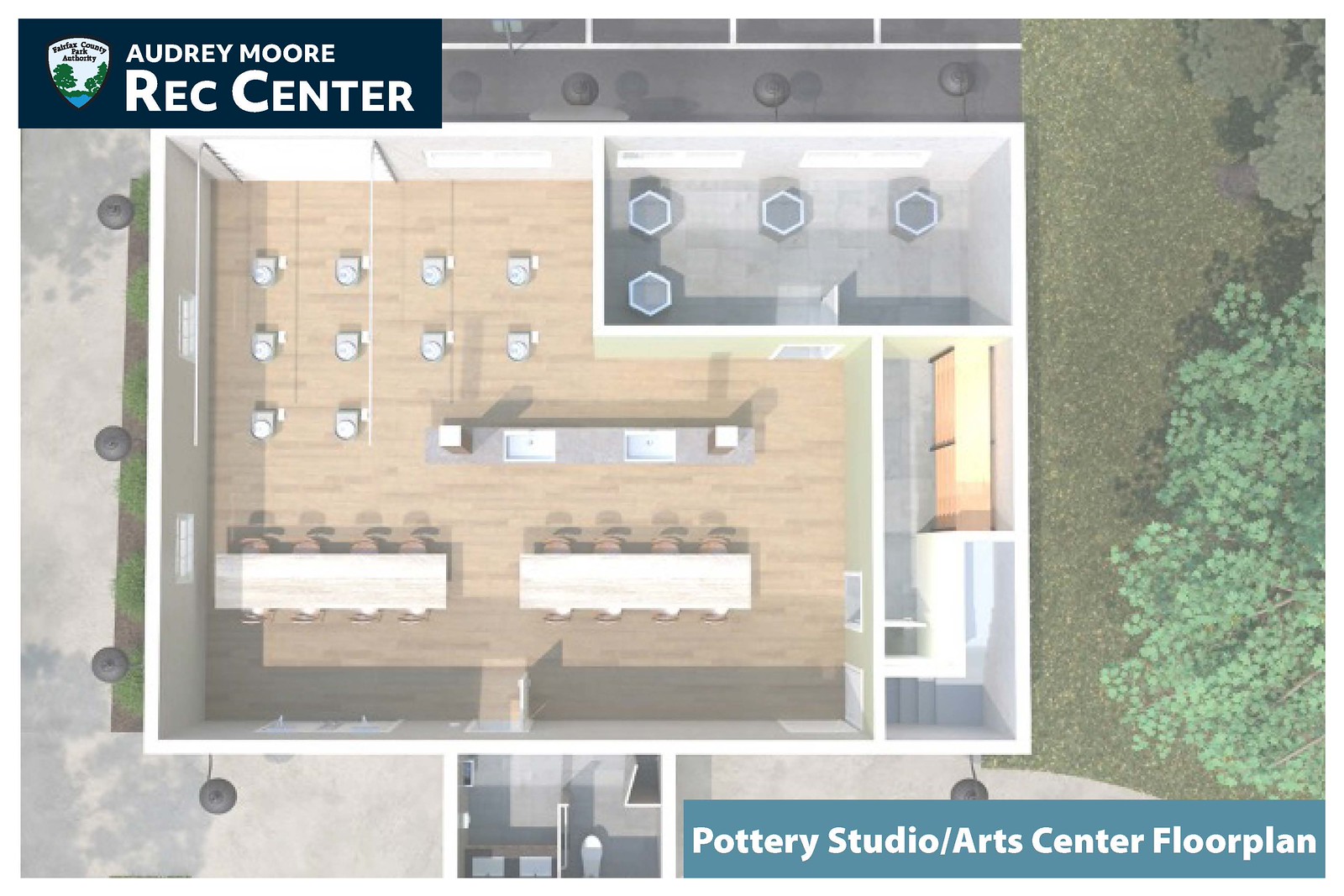
Pottery deserves its own question. The March presentation discusses a separate pottery building and identifies Wakefield Park and Mason District Park as options, with the goal of reducing disruption. The public design boards show alternatives. They should not be read as proof that one final destination has been selected or that uninterrupted pottery service is guaranteed.
Outside, the county says amenities will remain available unless construction affects user safety; parking may be restricted or rearranged. That is important for people who visit Wakefield without entering the rec center. Check future access notices for your actual destination instead of assuming either that the entire park will close or that every route will remain unchanged.
A separate pottery concept
What to watch next
Follow the decisions that will change the everyday experience.
The May 2 public meeting has already happened, and the formal comment period closed June 5. The county’s engagement page keeps the project materials together and lists parkmail@fairfaxcounty.gov for questions. Follow the next design update rather than treating an old invitation or comment form as a current deadline.
Useful questions are specific: Where will a particular camp move? When will pottery’s location be settled? How will accessible drop-off work during construction? What will childcare hours and eligibility be? When will the senior-center transition plan be published? These are the details that turn a major capital project into something residents can plan around.
For the November 3 referendum, use the Office of Elections for polling-place and voting information, and the county bond page for the actual question. Then watch the funding decisions, updated plans and construction notices together. The renderings explain the ambition; those later decisions will determine when and how the next Audrey Moore serves Annandale.
Why this matters locally
A park Audrey Moore helped protect is preparing for another generation. The real measure will be better spaces and a workable transition for the people who use them.
Sources and further reading
Where the reporting comes from.
This article draws on public records, official statements, and attributed local reporting. Each link opens the original source.
- Fairfax County Park Authority: reconstruction scope, estimated schedule and FAQ; checked October 31, 2026 ↗
- Fairfax County Park Authority: project announcement, April 2, 2026 ↗
- Fairfax County Park Authority: 2026 Park Bond Referendum, funding categories and facility needs; checked October 31, 2026 ↗
- Fairfax County: Audrey Moore public-input page; May 2 meeting and June 5, 2026 closed comment period ↗
- Fairfax County Park Authority: current Audrey Moore visitor information; checked October 31, 2026 ↗
- Park Authority Planning and Development Committee, March 25, 2026: replacement approval, building conditions, budget and concept plans, PDF pages 16–39 ↗
- Virginia General Assembly: House Joint Resolution 961, memorial to Audrey Elizabeth Moore, February 2019 ↗
- Braddock Heritage: Audrey Moore oral history, May 19, 2005, transcript and archival portrait ↗
- Fairfax County History Commission: Board of Supervisors chairmen, including Audrey Moore’s 1988–1991 term ↗
- Fairfax County: November 3, 2026 bond questions and explanatory materials ↗
- Board of Supervisors summary, April 29, 2002, PDF page 30: May 4 rec-center renaming and Wakefield preservation ↗
- DLR Group / Fairfax County Park Authority: community survey report, January 21, 2022 ↗
- Park Authority Planning and Development Committee, January 14, 2026: quarterly project report and completed pool-hall repairs ↗
- DLR Group / Fairfax County Park Authority: official Audrey Moore concept boards, published May 5, 2026 ↗
- Fairfax County DPWES: Braddock District capital-project report, September 2026, PDF page 3; $110 million project estimate ↗
- Fairfax County: Parks and Park Facilities ballot question and plain-language explanation, 2026 ↗
- Fairfax County Office of Elections: official voting and polling-place information ↗
- Park Authority Planning and Development Committee, October 28, 2026 work plan, PDF page 5: design status and differing construction dates ↗