The local story
Dulles is putting part of its airport land to work as a power plant. Dominion Energy’s solar-and-storage project occupies an 835-acre site in the airport’s southwest corner, with electricity intended for the regional grid and a separate package of benefits for the airports.
The scale is striking: 100 megawatts of solar generation and a battery designed to store 200 megawatt-hours of electricity. So is the land-use tradeoff. A 2022 environmental review projected the removal of about 775 acres of forested vegetation. Understanding this project means looking at both the energy it can deliver and the land it changes.
As of the October 28, 2026 check, Dominion still lists Dulles International Solar as under construction, with operations anticipated in 2026. The latest EIA inventory now lists December as the planned operating month. An announced target date is not confirmation that the project has switched on.
The project at a glance
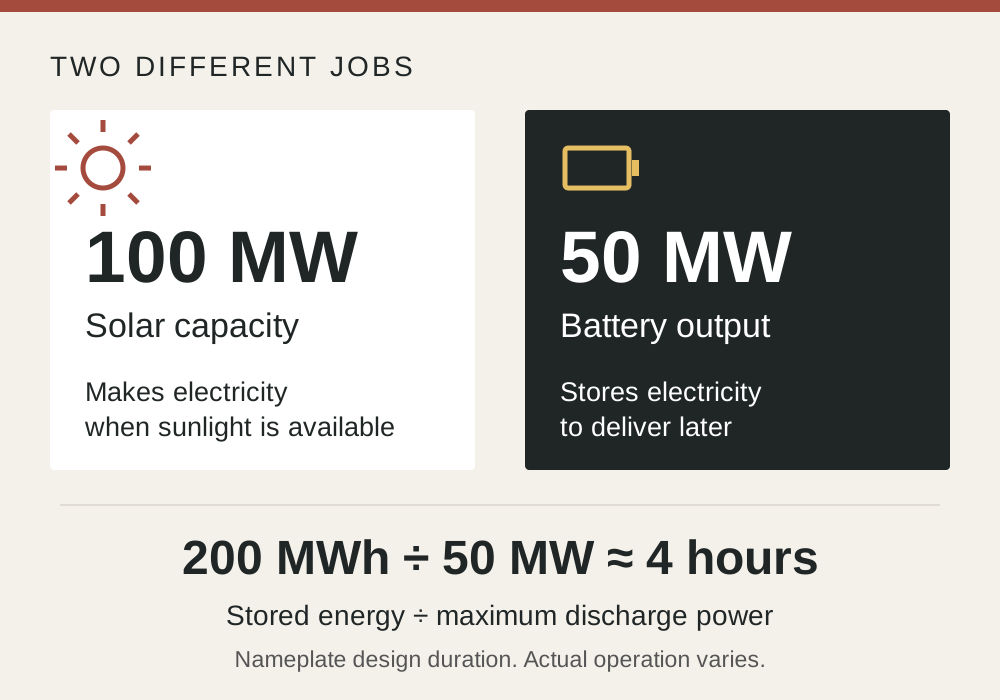
Solar makes the electricity. The battery shifts when it can be used.
The two headline power numbers describe different equipment. The solar array is rated at 100 megawatts, or MW. The battery can discharge at up to 50 MW and has a nameplate energy capacity of 200 megawatt-hours, or MWh. Calling the whole installation “150 MW of solar” would blur that distinction.
A megawatt describes how quickly electricity is being produced or delivered. A megawatt-hour describes an amount of energy. Think of the battery’s 50 MW as the size of the outlet and its 200 MWh as the size of the tank. Dividing the stored energy by the maximum discharge power gives about four hours at that output. Actual operation depends on charge level, losses and how the system is dispatched.
Read the units, understand the project
Put it on the map
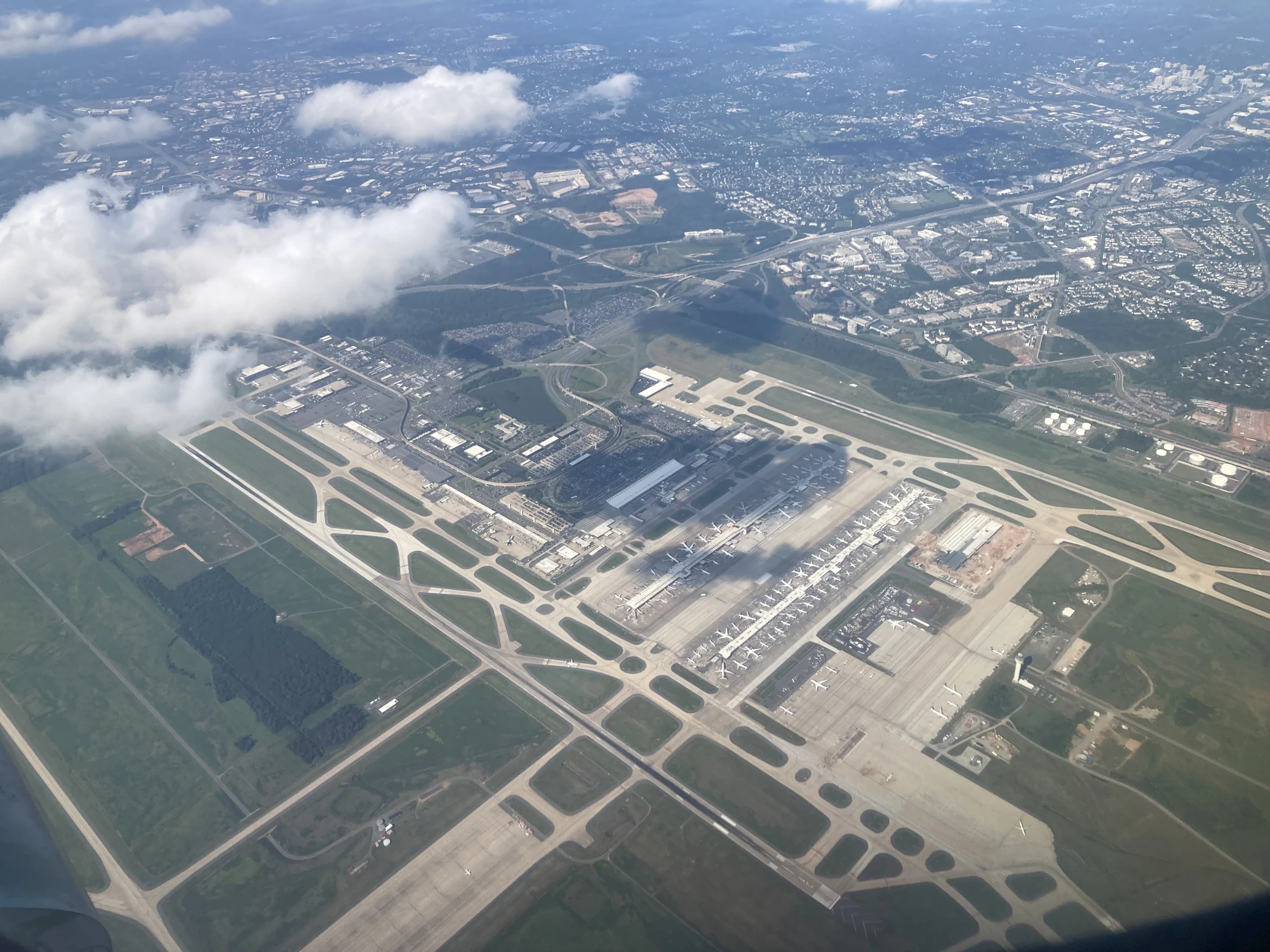
The southwest corner of a much larger airport
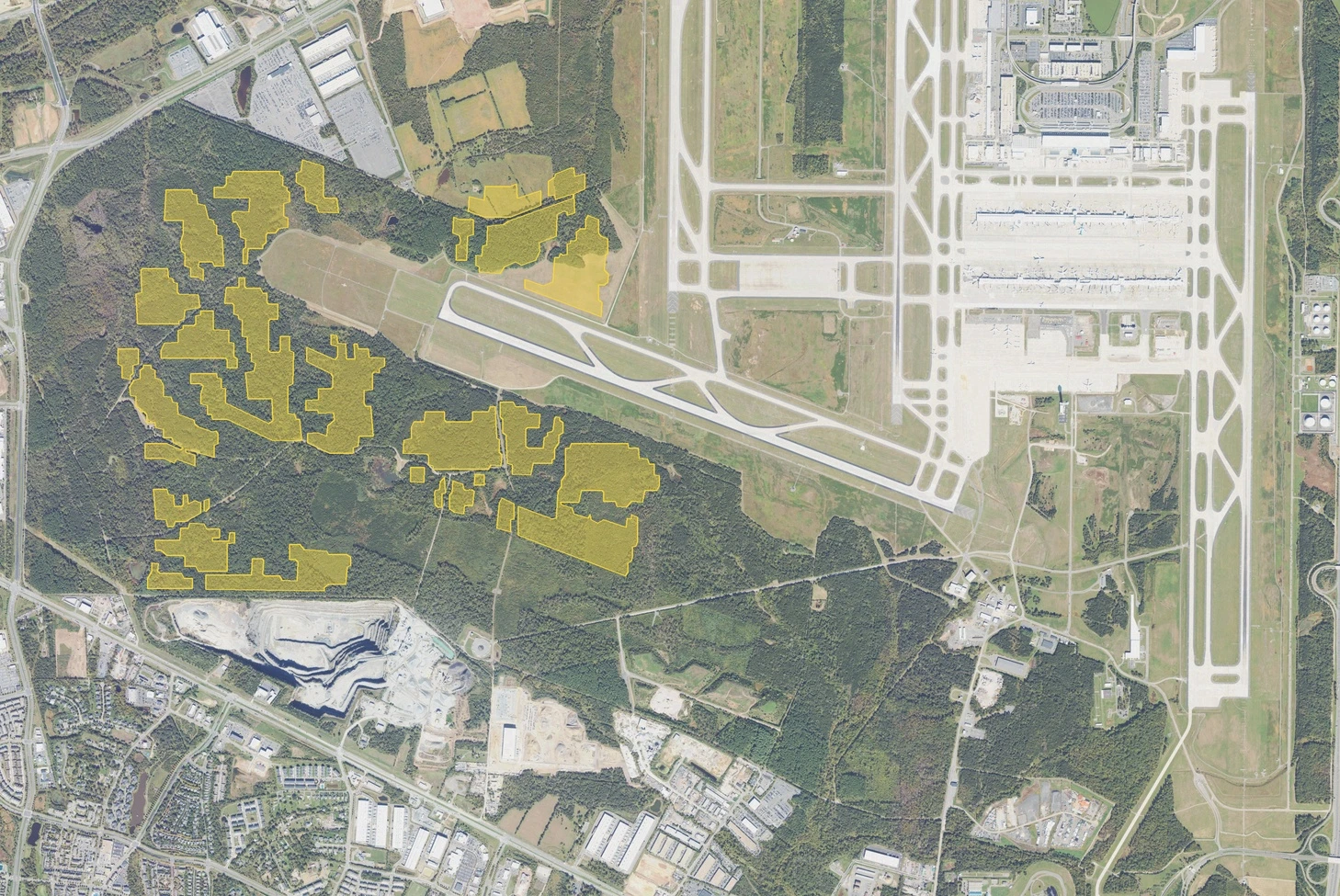
The planned arrays spread across airport land west and south of the diagonal Runway 12/30. In the overview below, the terminal and concourses sit toward the upper right. The solar areas occupy separate shapes around existing airport infrastructure rather than one uninterrupted rectangle.
The yellow overlay follows the approximate array areas shown in Dominion’s March 2025 plan. It has been aligned to public-domain aerial photography taken October 11, 2023. The photography is historical, and the overlay is a planning illustration: together they help explain the location, but they cannot show today’s construction progress.
The shaded shapes also cover a different thing from the full 835-acre project site. Roads, battery equipment, substations and other project components are outside the array shading. The overlay should not be used to measure the lease boundary or the number of acres cleared.
Where the planned arrays fit
NORTH IS UP · YELLOW = APPROXIMATE PLANNED ARRAY AREAS
Who gets the power?
The “37,000 homes” comparison needs one important qualifier
Dominion’s groundbreaking announcement said the combined solar-and-storage project could supply the equivalent of more than 37,000 Virginia homes at peak output. That is a comparison of power at maximum output, rather than a promise to supply the same homes every hour of every day.
Solar output varies through the day and falls when sunlight is unavailable. Storage can hold electricity and release it later, including when solar production drops. The battery makes the timing more flexible; it does not turn a finite amount of stored energy into an unlimited supply.
The main project supplies Dominion Energy Virginia customers through the grid. Electricity from the site becomes part of that wider system. The airport’s name identifies where the project sits, rather than an arrangement in which all its electricity is reserved for the terminals.
There is a separate airport-facing piece: two planned solar carports, each rated at 1 MW. Dominion’s announcement says those installations will partially power Dulles facilities. The main solar farm and the airport carports have different roles and schedules.
The land tradeoff
This was forested airport land, too
Airport property can sound like spare space. The environmental record shows why that description is incomplete here. The December 2022 Final Environmental Assessment projected removing approximately 775 acres of forested vegetation for the western solar development.
That is a substantial land change alongside the renewable-energy benefit. The assessment’s vegetation table includes deciduous, coniferous and mixed forest, as well as open field. The project’s 835-acre footprint should not be described as an already paved site.
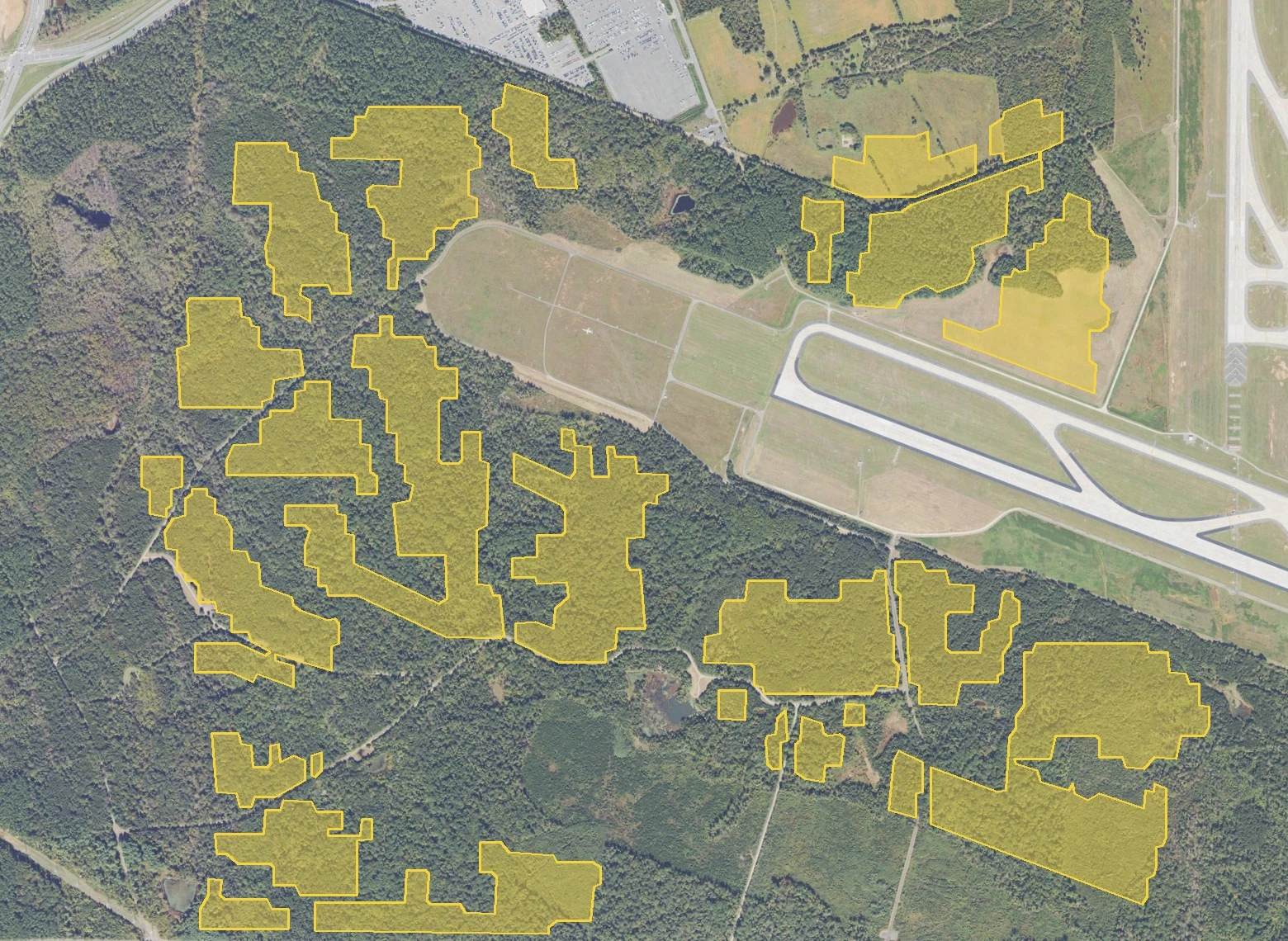
The date and meaning of the 775-acre figure matter. It is an impact estimate for the proposal assessed in 2022. We have not verified an updated, as-built tally of the forest actually removed. Neither the number nor the map below should be presented as a measured account of completed clearing.
The close aerial view makes the planning tradeoff tangible. Trees are visible beneath and around the proposed array shapes in the 2023 imagery. Some planned areas also overlap land that was already open. The fair question is how the energy and airport benefits compare with the change to this particular landscape, rather than assuming every acre had the same starting condition.
The forest beneath the plan
HISTORIC AERIAL · OCTOBER 2023 · APPROXIMATE MARCH 2025 OVERLAY
What the airports receive
Part of the rent arrives as work vehicles, buses and solar carports
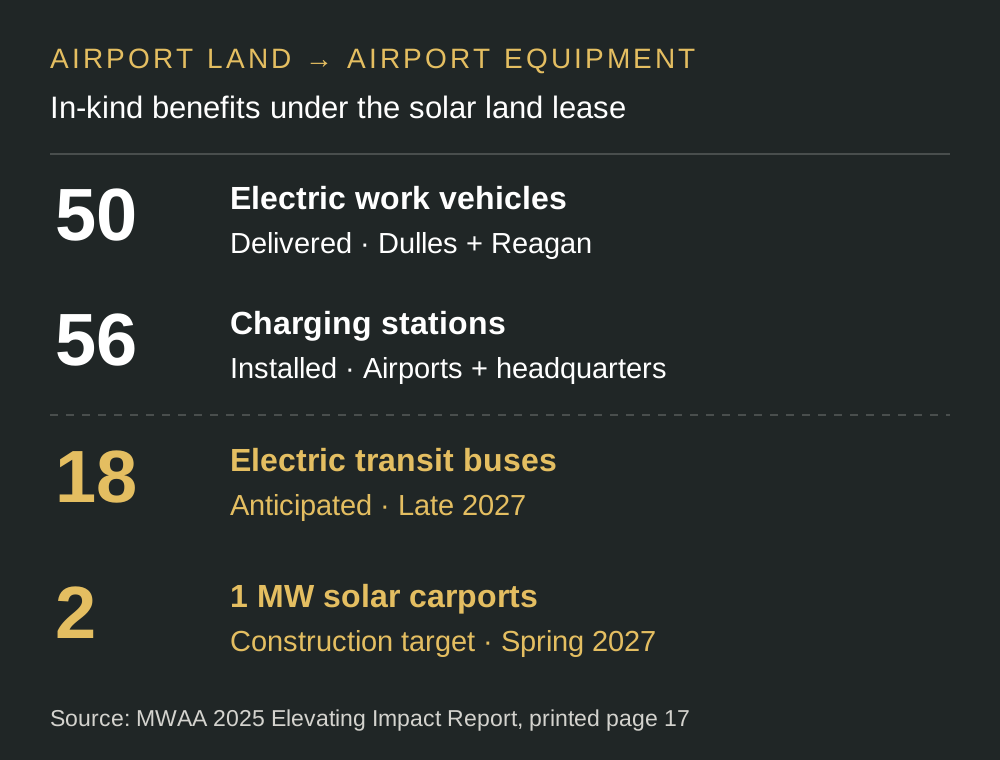
The Metropolitan Washington Airports Authority, which operates Dulles and Reagan National, receives an in-kind package under the solar land lease instead of annual cash lease payments. That connects the project to equipment used in the airports’ day-to-day operations.
The latest MWAA impact report says 50 electric work vehicles have been delivered for deployment at Dulles and Reagan according to fleet replacement schedules. These are light-duty airport fleet vehicles. Public reporting reviewed for this article did not establish a department-by-department allocation, so it would be premature to assign particular vehicles to security, baggage or maintenance duties.
The same report records 56 charging stations installed across Dulles, Reagan National and the authority’s Crystal City headquarters. It anticipates 18 electric transit buses by late 2027 and construction of the two 1 MW solar carports beginning in spring 2027. The buses are for airport transportation; their specific routes and models were not verified.
Delivered equipment and future milestones
The timeline
One project, several different clocks
The lease approval, environmental review, groundbreaking, main facility and airport benefits are separate milestones. That helps explain why one part can be delivered while another still has a future target date.
EIA’s September 2026 monthly generator inventory, released October 23, still lists both the solar and battery units as under construction and more than 50% complete. Their planned operating date has moved to December 2026, compared with September in the preceding inventory. Dominion’s project page also continues to describe construction and anticipated operations in 2026. This is an updated forecast, not confirmation that commercial operation has begun.
The next meaningful confirmation would be an actual operating announcement or an updated operating record. A completed environmental-review process, a groundbreaking photograph or an elapsed forecast date cannot substitute for that milestone.
What it means for NOVA
A big energy project deserves a specific local conversation
For Northern Virginia, this is a visible example of how major infrastructure uses land. The project adds solar generation and storage to the regional power system, gives airport property another role and helps replace part of the airports’ vehicle fleet. Its footprint also changes a wooded landscape on the edge of the airfield.
For someone living nearby or deciding where to buy, the useful information is the location, the land-use change and the verified construction status. The sources reviewed here do not establish a particular reduction in a household electric bill or an increase or decrease in nearby home values. Those claims would need their own evidence.
The questions worth returning to are concrete: when does the facility enter operation, what do the completed site and updated environmental records show, and do the remaining airport benefits arrive on the reported schedule? Those answers will tell us more than the headline acreage alone.
Why this matters locally
Dulles is becoming a larger part of Northern Virginia’s energy system. The story is the electricity, the timing of storage, the airport benefits and the land changed to make it happen.
How do you weigh the added solar power and airport benefits against the loss of forested land?
Sources and further reading
Where the reporting comes from.
This article draws on public records, official statements, and attributed local reporting. Each link opens the original source.
- Dominion Energy: groundbreaking, project capacities, peak-output comparison and lease benefits, August 22, 2023 ↗
- Dominion Energy: Virginia Solar Projects, current Dulles construction status, checked October 28, 2026 ↗
- U.S. Energy Information Administration: final 2025 Form EIA-860 data; proposed storage unit DUST, plant 65043 ↗
- U.S. Energy Information Administration: September 2026 monthly generator inventory, released October 23, 2026; plant 65043, DUSO and DUST ↗
- MWAA: 2025 Elevating Impact Report, printed page 17; vehicles, chargers, buses and carports ↗
- MWAA: December 2022 Final Environmental Assessment, forest-clearing projection on printed page 4-13 (PDF page 143) ↗
- Dominion Energy: March 6, 2025 presentation, planned Dulles project layout on slide 18 ↗
- USDA / USGS: National Agriculture Imagery Program aerial imagery service ↗
- USGS: public-domain use of data downloaded from The National Map ↗
- Dclemens1971: Aerial view of Dulles Airport 01, photographed July 24, 2025, via Wikimedia Commons ↗
- Creative Commons Attribution 4.0 license for the Dclemens1971 airport photograph ↗
- MWAA: March 16, 2022 board and committee meeting materials, solar lease approval ↗