The local story
You can add more trains to a timetable. Getting them through the same stretch of railroad without waiting for one another is the harder part. Just south of Franconia–Springfield VRE station, Virginia is addressing that problem with a bridge that carries passenger trains over the freight tracks.
The project is called the Franconia–Springfield Bypass. It is part of the working railroad used by VRE, Amtrak and freight trains, rather than an extension of Metro. VPRA lists it as under construction with a $532.8 million total budget. The interesting part is why trains need to cross here at all, and why building the solution involves temporary tracks before the permanent bridge can do its job.
Start with the geography
The passenger tracks change sides here.
North of the bridge, the passenger route belongs on the west side of the corridor. South of the bridge, it belongs on the east side, to reach the passenger station platforms. Following the route south, a train therefore needs to move from west to east across the freight railroad. This is a track-layout problem, not simply a shortage of trains.
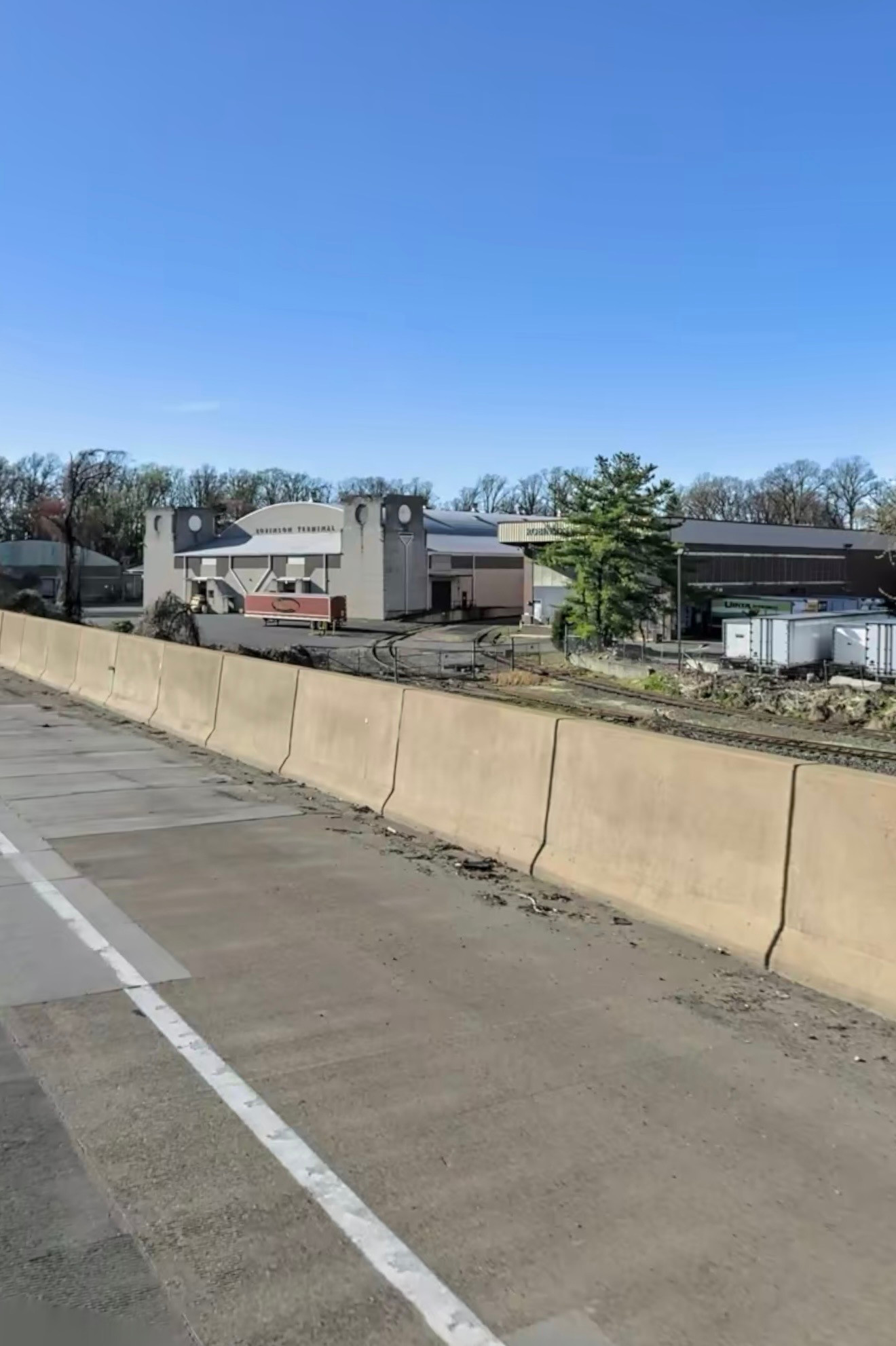
The work is immediately south of the Franconia–Springfield VRE station, with the construction diagrams continuing toward Newington Road. The familiar Metro station helps locate the area, but the project serves a different rail system. A Blue Line rider will not suddenly find a Metro train traveling over this bridge.
That location explains the name: the bypass provides a route around an operating conflict. It does not bypass the community by sending trains to an entirely new regional corridor. The passenger and freight routes remain beside one another, with a change in elevation where their paths need to cross. VPRA’s June 2023 project-locations display, linked in the sources, provides geographic context for the bypass and third track. Its old schedule labels are historical, not the current timetable.
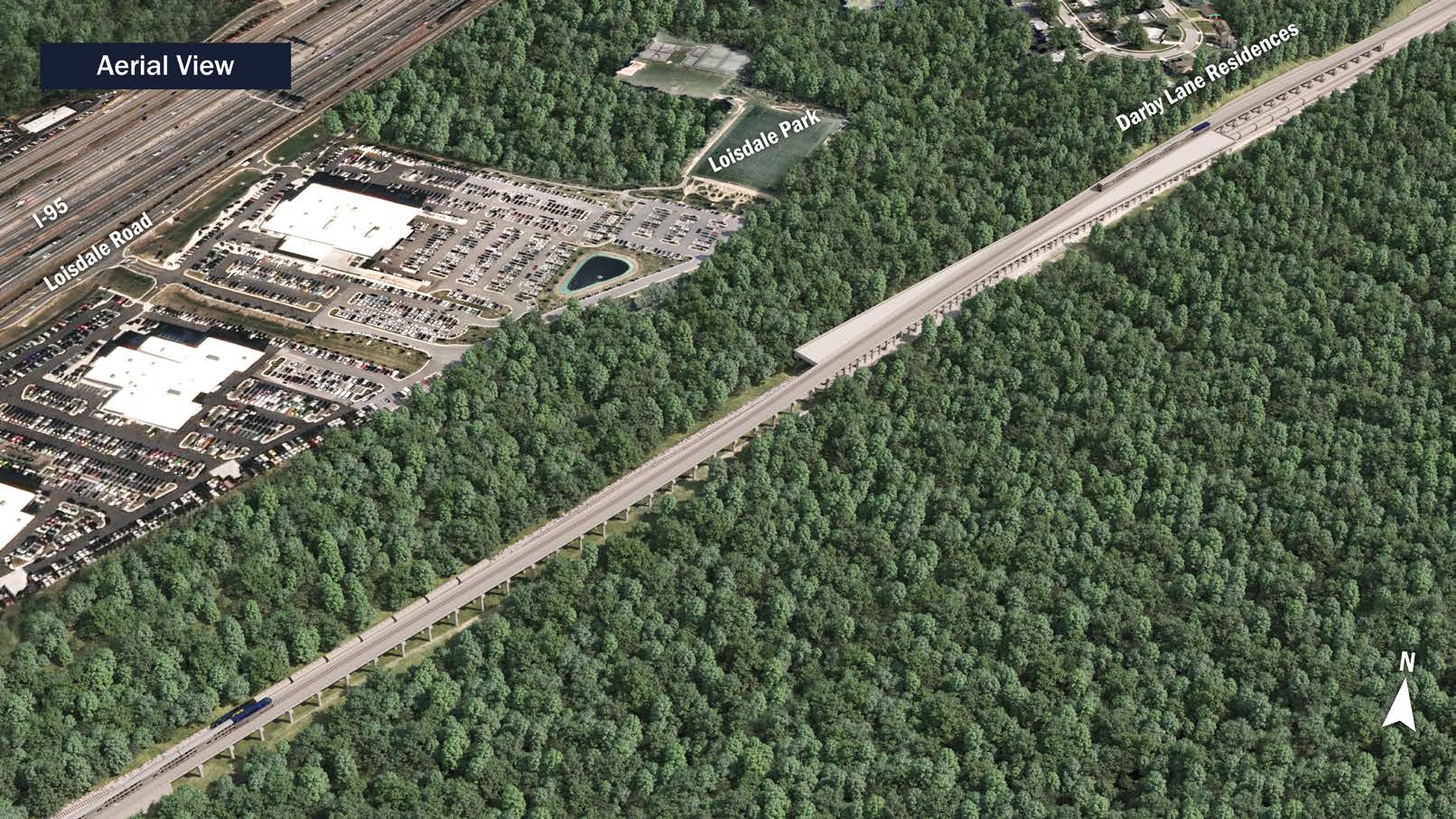
Where the bridge fits beside Loisdale Park
The operating problem
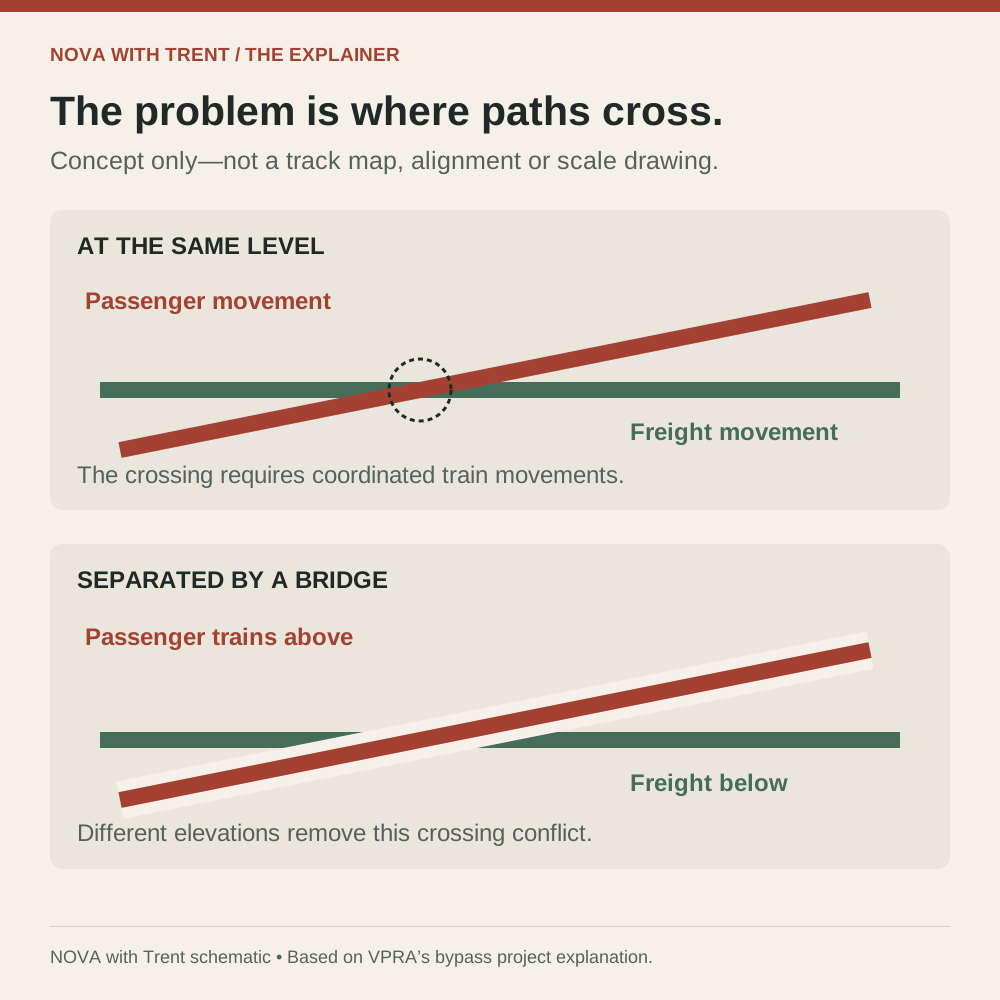
A crossing can hold up more than the train using it.
At a same-level rail crossing, the dispatcher has to protect a train's movement across the other route. Two incompatible movements cannot occupy the crossing together. In practical terms, a passenger train changing sides can require a freight movement to wait, and a freight movement can delay the passenger train's opportunity to cross.
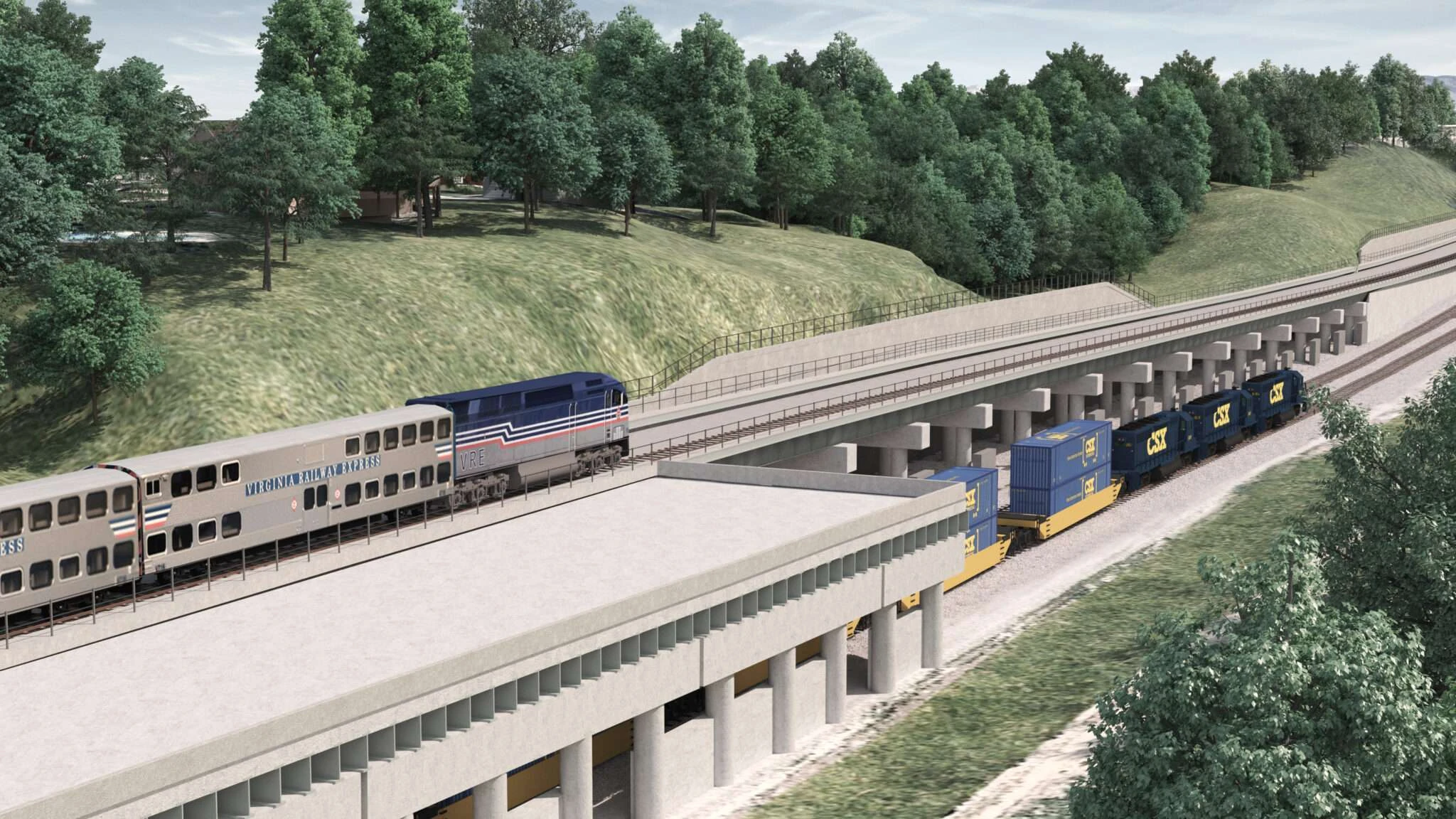
The flyover changes that geometry. Passenger trains rise above the freight tracks, cross them, and return toward ground level on the other side. Separating the routes vertically removes this particular conflict rather than trying to squeeze more conflicting movements into the same available gaps.
Think of a highway interchange where a ramp goes over the main road instead of crossing its lanes at a traffic light. That analogy explains the separation; it does not mean railway operations become unconstrained. Signals, station stops, track availability elsewhere and dispatching still matter. The useful claim is that this bottleneck is removed, not that every future train can run without delay.
VPRA says the result should improve reliability for passenger and freight service and reduce freight idling. For a commuter, reliability can matter as much as top speed: a timetable is more useful when the route has fewer places where one movement has to wait for another.
Why going over the tracks helps
The structure
The approach ramps are part of the story.
The bridge is more than the moment when one train passes above another. Tracks must climb to the crossing and descend again. VPRA describes raised-earth approaches held by retaining walls, connected by a bridge with multiple spans. Those approaches help explain why a single crossing requires a substantial construction footprint along the corridor.
Parsons, the project's engineer of record, describes a design with supports placed outside the CSX tracks and sections that span over those tracks. It also identifies retained-fill approaches and challenging ground conditions. That combination means the job involves foundations, earthwork, drainage and retaining structures alongside the visible bridge beams.
The initial construction provides one passenger track on the bypass, while accommodating a possible second track later. Space reserved for future expansion is useful, but it should not be counted as a second operating track delivered by this phase. Likewise, the concept image at the top is an illustration of the future structure, not evidence that the bridge is complete.
Published descriptions use different length figures: the engineer identifies a 3,400-foot bridge, while older VPRA descriptions refer to an approximately mile-long bypass. Those figures may describe different extents, including approaches. They should not be combined into a precise footprint without the engineering plans.
Building beside live trains
First, create room to build.
The unusual word on the construction plan is shoofly. It means a temporary railway detour immediately alongside the mainline. Instead of sending riders onto a different regional route, trains use temporary track around the work area so crews can build portions of the permanent project.
The official November 2025 plan below shows the temporary-track concept near the station and toward Newington Road. Read it as an explanation of staging. It is not a live map showing which line is carrying trains this afternoon, and the lines should not be interpreted as public access paths.
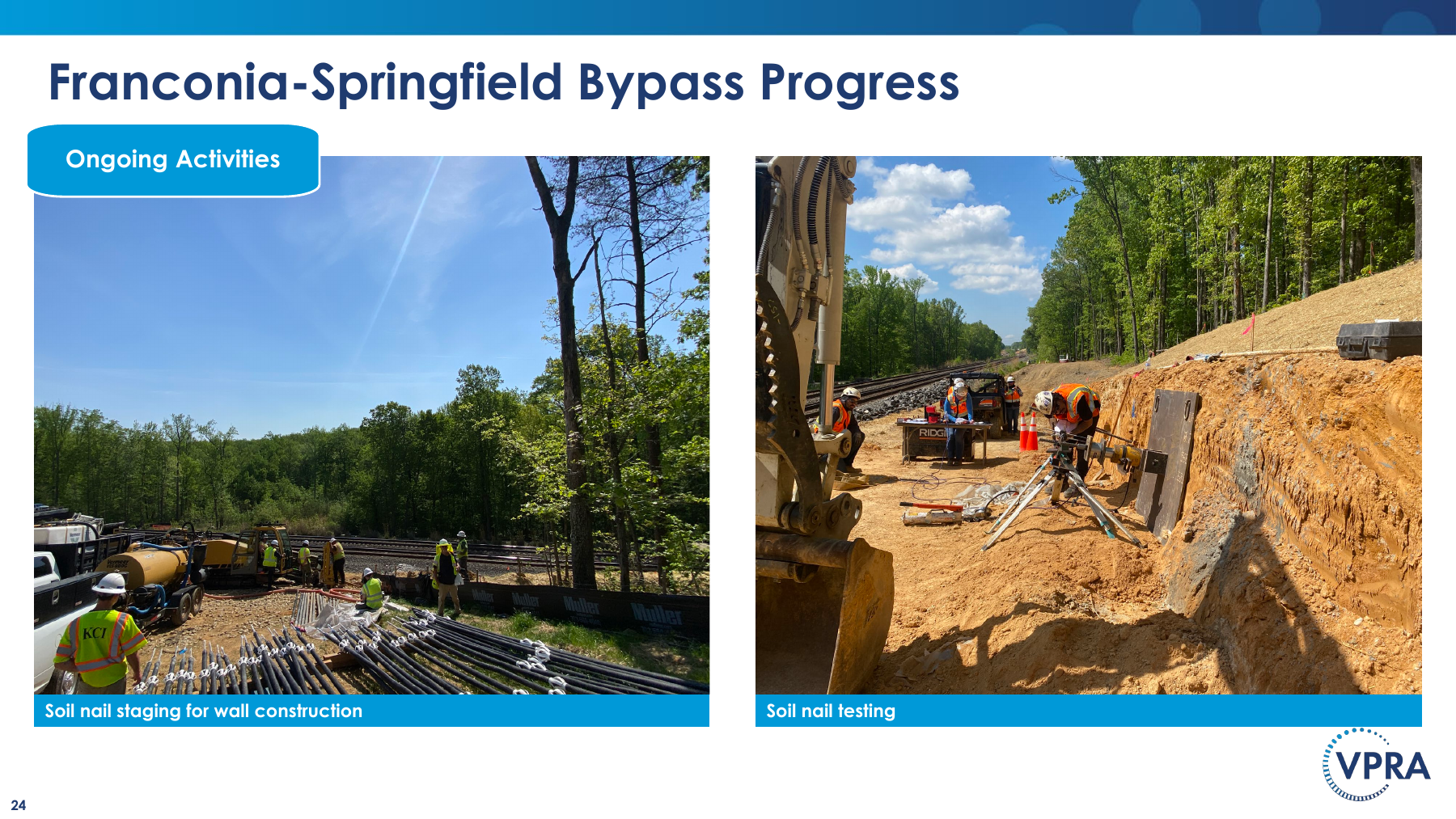
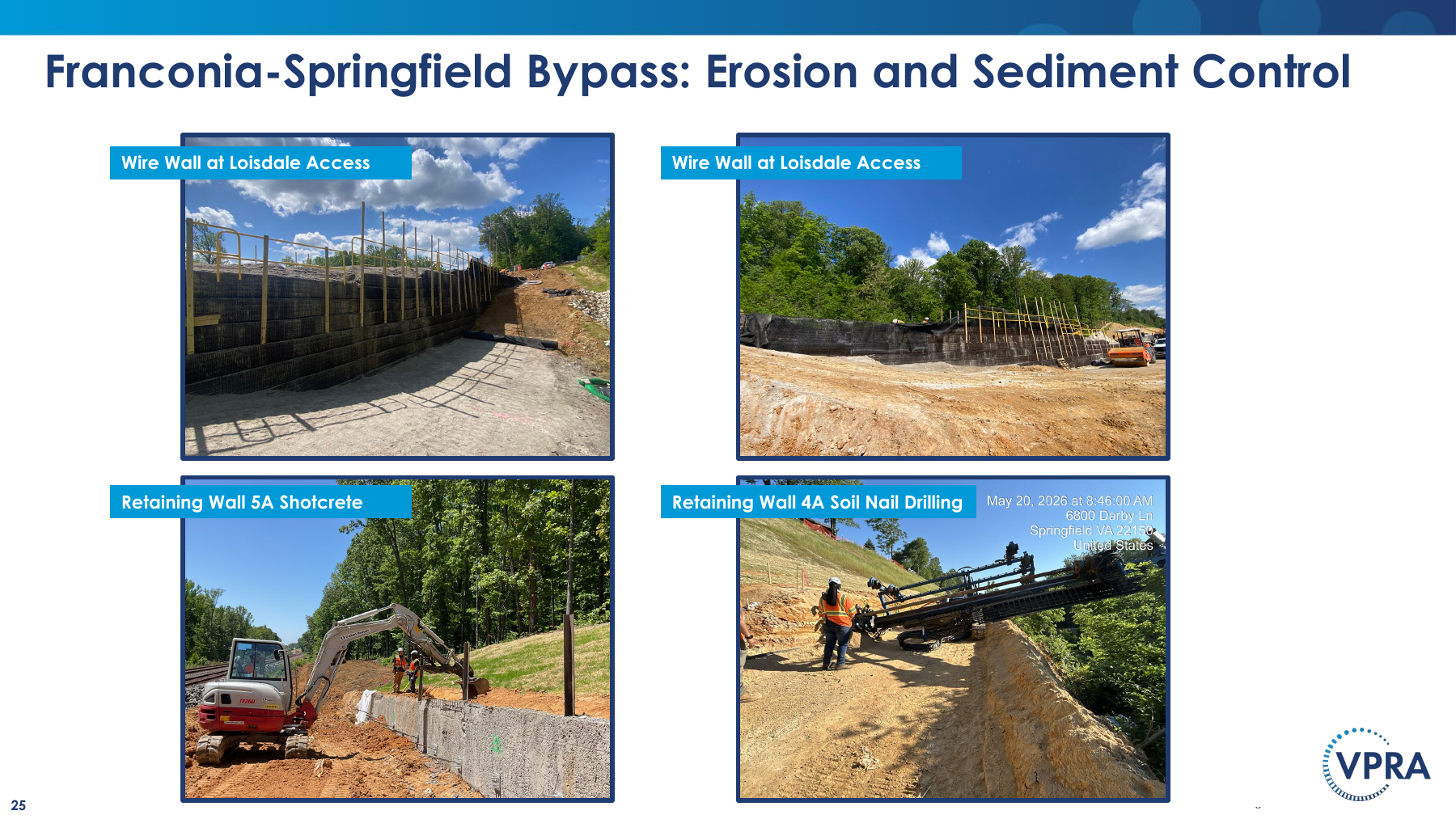
By June 2, 2026, VPRA reported temporary crossings and access work complete, with retaining-wall construction, utility relocation and structural-steel fabrication underway. The presentation’s photographs show soil-nail testing, wall construction and drainage-related site preparation. They reveal the less visible part of a flyover: stabilizing the ground and building its approaches before the bridge can carry trains.
The September 2026 Executive Director’s Report records another step: drilled-shaft construction had started for Unit B. Retaining-wall work, fiber relocation and utility investigations for drainage were continuing. These are dated progress reports, not a claim that every pictured activity remains in the same condition today. The same report also flags a gas-pipeline relocation issue affecting the schedule, discussed below.
Construction next to an operating railroad also has to fit around trains. VPRA explains that some tasks need nighttime windows because daytime traffic leaves insufficient space to work safely. The agency says it aims to do as much as possible during the day. A promise to maintain passenger service during construction should therefore not be read as a promise of unchanged timetables or no overnight activity.
VPRA’s temporary-track concept

What construction actually looked like
The walls and ground work behind the flyover
Follow the money
The budget is larger than the bridge contract.
VPRA's current project page gives a total budget of $532.8 million. It identifies $22.9 million from the Northern Virginia Transportation Authority and a $100 million federal CRISI grant. These are contributions toward the project, not amounts to add on top of the published total.
CRISI is the Federal Railroad Administration's Consolidated Rail Infrastructure and Safety Improvements program. VPRA's 2023 grant announcement said the federal award would support final design and construction. Federal, state and local participation reflect the fact that the corridor carries more than one operator's trains and serves a region larger than Springfield.
Older coverage can be confusing. The 2023 grant announcement used a $405 million project figure and an earlier construction schedule. Those numbers describe what was being announced then. This guide uses the current project-page budget and identifies newer schedule evidence separately. It does not assume the difference between two historical totals is explained by any single cause.
Timing and uncertainty
Construction is underway. The opening date still needs clarification.
VPRA’s current project webpage lists the bypass as in construction but does not give a detailed opening timetable. Two dated agency documents show different estimates: the July 2026 programmatic real-estate plan lists bypass completion in 2030, while the September 2026 Executive Director’s Report lists 2029. Those dates should not be presented as one settled passenger-service opening date.
The September report also describes an anticipated delay of approximately 12 months associated with coordinating the Kinder Morgan gas-pipeline relocation. Its August shoofly-subbase milestone is marked off track. The report does not resolve how that delay relates to the conflicting published completion estimates, so adding a year to either date would create an unsupported forecast.
The July plan separately lists the Franconia-to-Lorton third track for 2029. That is a neighboring project, not confirmation that the bypass opens that year. Physical completion, testing and commissioning, and a new passenger timetable are distinct milestones. Riders should wait for a reconciled project schedule and operator announcements rather than plan around a guaranteed opening day.
The surrounding work
Three local projects, three different jobs.
The bypass sits within a larger effort to separate and expand rail operations. The Franconia-to-Lorton Third Track project adds six miles of mainline track between the stations, creating a continuous third-track corridor from Alexandria to Lorton. VPRA says it also involves replacing the Newington Road railroad bridge and widening the bridge over Lorton Road.
VRE's station project addresses the passenger-facing side: longer platforms and a pedestrian tunnel. VPRA's Winter 2026 update described construction as expected to begin in early 2027, with pedestrian access from Barry Road maintained during construction. Treat that as the dated forecast it is; check the station's notices before relying on an access route.
Farther north, Long Bridge and Alexandria track work address other constraints. Their benefits are connected to this project, but their work windows can also affect the same riders. If your train's schedule changes, the cause may be work elsewhere on the route rather than the bridge outside Springfield.
| Project | Main job | What it does not mean |
|---|---|---|
| Franconia–Springfield Bypass | Carry passenger trains over freight tracks. | A new Metro line or station. |
| Franconia–Lorton Third Track | Add six miles of mainline capacity and related bridge work. | A second track operating on the bypass immediately. |
| VRE station improvements | Extend platforms and provide a pedestrian tunnel. | The same contract or completion date as the bypass. |
What changes for you
Better rail is useful. Construction is still construction.
For VRE and Amtrak riders, the intended benefit is a more dependable corridor with capacity to support additional service. The flyover does not, by itself, establish a new fare, a guaranteed commute-time saving, a weekend timetable or a particular train frequency. Those outcomes depend on the broader network, operating agreements and published service plans.
For nearby households, the immediate questions are more concrete: where trucks enter, when nighttime work occurs, whether walking routes change and who will respond to a problem. VPRA's neighborhood updates identify construction traffic, equipment noise, vegetation removal and utility relocation as issues to follow. Conditions differ by location and phase; a corridor-wide notice does not mean every street experiences the same work.
Use VPRA's construction-disruptions page for detours and work notices, and VRE or Amtrak for the train you intend to ride. For a construction concern, the Winter 2026 update provides construction@vpra.virginia.gov and 844-878-8772. Include the location, date, time and specific activity when reporting a problem so the project team can identify the work involved. The most useful follow-up question is specific: which work package is active near this location, what hours apply, and when will the next notice be issued? That gives residents something they can act on without treating an early planning illustration as a final construction instruction.
If you are evaluating a home nearby, separate today's conditions from the promised future benefit. Walk the actual route to the station, check the current timetable against your working hours and review notices for the particular street. A stronger rail connection can improve daily choices; this project alone is not evidence of a specific increase in a property's value.
Why this matters locally
This is a small crossing with consequences well beyond Springfield. Separating train paths can make the shared corridor work better. For nearby residents, the project is also a multiyear construction story whose access, noise and schedule details deserve as much attention as the finished rendering.
Sources and further reading
Where the reporting comes from.
This article draws on public records, official statements, and attributed local reporting. Each link opens the original source.
- VPRA: current bypass status, scope, budget and project information ↗
- VPRA: November 20, 2025 community presentation and shoofly plan ↗
- VPRA: construction disruptions and detours ↗
- VPRA: July 2023 Franconia-area questions and project geography ↗
- VPRA: bypass FAQ and explanation of east–west passenger movements ↗
- Parsons: engineer-of-record description of the bridge and approaches ↗
- VPRA: 2023 CRISI award announcement (historical budget and schedule) ↗
- VPRA: Winter 2026 construction update and neighborhood contacts ↗
- VPRA: July 2026 programmatic plan, schedule (printed page 7 / PDF page 12) ↗
- VPRA: Franconia-to-Lorton Third Track scope ↗
- VPRA: construction questions by email ↗
- VRE: current rider information and service notices ↗
- Amtrak: service alerts and notices ↗
- VPRA: June 2023 official project-locations map (historical schedule labels) ↗
- VPRA: September 2026 Executive Director report, construction and schedule (page 27) ↗
- VPRA: June 2, 2026 community presentation, construction photos and progress ↗
- VPRA: June 2023 bypass rendering board ↗