The local story
Merrifield’s old drive-in did not leave people with just a list of movies. It left them with stories about the circumstances: who they went with, where they parked, how they stayed warm and what happened around the edges of the screen.
That is the more interesting way to remember the Lee Highway Drive-In. Before Mosaic’s restaurants and sidewalks, before the indoor multiplex, this was a place where an ordinary car became a private little movie theater inside a much larger gathering.
The photographs and advertisement below show the physical place. The named recollections come from publicly published accounts, not invented scenes or private neighborhood comments. Memories can preserve the feeling of a night without settling every date. Both kinds of evidence belong in the story.
1954 • A promise bigger than the movie
The sign sold an entire evening.
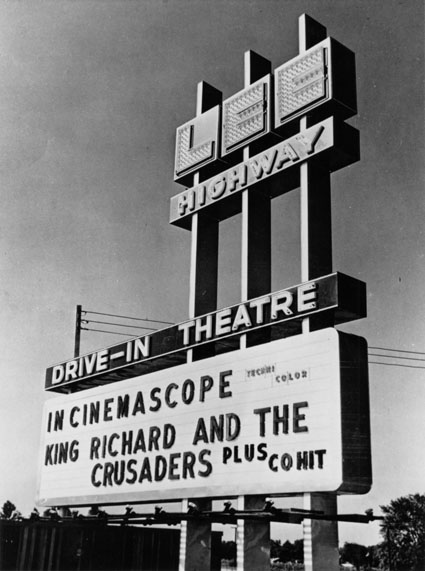
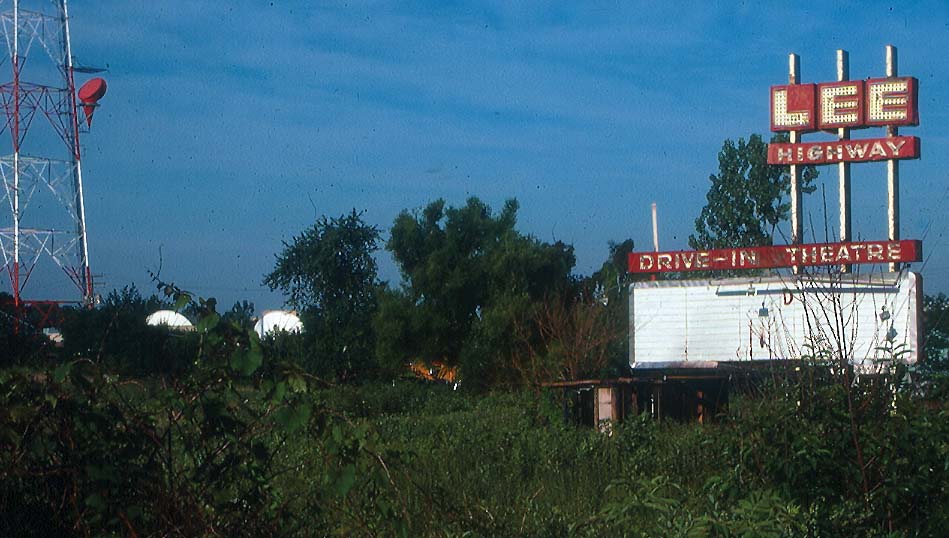
Look at the towering sign in the 1954 photograph. The theater announced itself from the road, with the movie title well above the cars. This was not a small screen tucked into an empty field: it was a destination designed to catch the eye before a driver reached the entrance.
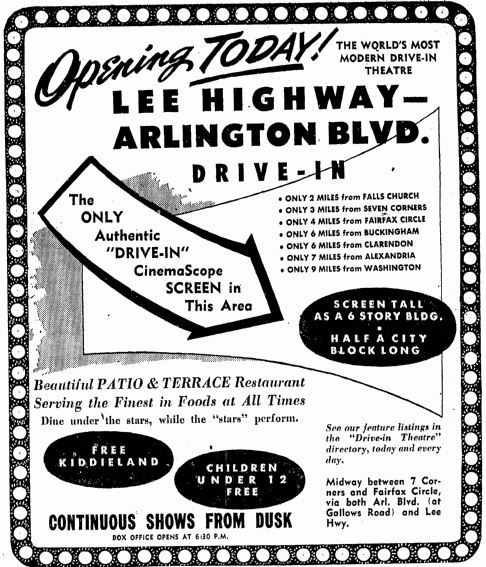
The opening advertisement makes the pitch even clearer. Children under 12 entered free. A playground and a patio-and-terrace restaurant were part of the attraction. The advertisement promised continuous shows beginning at dusk, with the box office opening at 6:30 p.m. The evening could start before the picture did.
Its extravagant screen-size comparisons were advertising language, not a survey. The more revealing detail is the mix of activities. Parents were being offered dinner, children’s entertainment and a movie in one place. Teenagers could read the same advertisement and imagine a very different evening.
The specialist theater history dates the opening to August 26, 1954. The photographic caption identifies the marquee view as 1954; the advertisement itself is an opening announcement, not a photograph of that first audience.
1966 • Read the landscape
A whole audience, arranged around one screen.
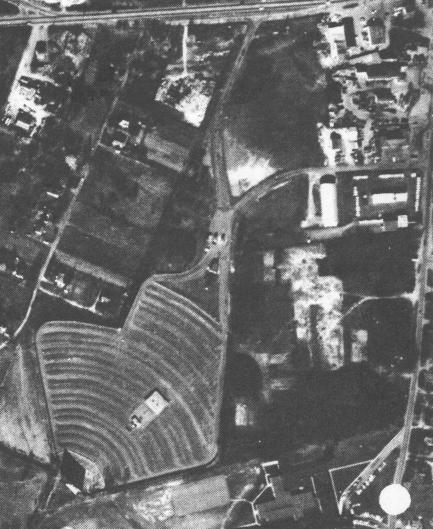
The aerial gives the old theater something a modern street view cannot: its shape. Curving rows spread across the viewing field. The central building sits among them, with paths and open areas interrupting the rows. Instead of an auditorium with a roof, the cars themselves formed the seating plan.
Cinema Treasures lists one screen and a later capacity of 1,353 cars. Its history describes entrances on both Lee Highway and Gallows Road. That is a very different kind of crowd from people filing through one lobby: the theater had to receive vehicles, place them where people could see and send them out again.
Pause on the image before jumping ahead to Mosaic. It explains why a drive-in memory is often about a particular parking spot. The lot was not just somewhere to leave the car before the experience. It was the experience.
The source identifies this as a 1966 aerial of Lee Highway Drive-In. The historical address was 8223 Lee Highway. This is the Merrifield property that preceded the multiplex and Mosaic, not the Super 29 theater on West Ox Road. The image is historical evidence, not a parcel survey or an exact overlay on today’s storefronts.
The people in the cars
Five memories the buildings cannot tell.
These are small, specific recollections, the kind that make a vanished place recognizable. They are attributed memories rather than independent verification of every event.
The date before the slumber party
Carolyn Bounds Botkin recalled dating in hair curlers before a slumber party: “Had to look good for my friends!”
The soundtrack was bigger than one car
Mike, a contributor to Drive-In Theatres of the Mid-Atlantic, remembered his usual parking spot, snack-bar smells, cool air and movie sound echoing across the lot.
Somebody had to keep everyone warm
Stan recalled working there in 1969–70, helping install electric in-car heaters and watching for people sneaking in. His account adds the employees to the picture.
A view from behind Levitz
Mark remembered watching from behind the Levitz furniture store as a Fairfax teenager in the early 1980s, until police arrived. He called it the Merrifield drive-in.
Sometimes the audience brought lawn chairs
In a personal essay published in 2024, Rob Furey remembered teenagers entering through a gap in the fence and setting lawn chairs around a cooler. He described metal posts with cabled speakers and the sound spilling from car spaces across the lot.
His account offers a different perspective from the front seat: an outdoor audience listening together, without everyone sitting inside a car. We use it here as an attributed recollection of the setting, not as a verified screening calendar or a reliable date for a particular film.
What these stories preserve
The film title is only the beginning.
A movie listing tells us what was advertised. A memory tells us what mattered to the person who went. Those are not always the same thing. A hairstyle, a cold evening or an improvised viewing spot can outlast the plot.
Furey’s description also helps a reader who never went understand the equipment. The sound was not simply projected from the enormous screen. In his memory, a cable connected the speaker to the post at a parking space. A little piece of theater hardware brought the soundtrack close to the audience; many such speakers made the lot sound different from an indoor auditorium.
It is tempting to turn these fragments into one perfect summer night. That would make a smoother story, but not a truer one. They come from different people and different years. The employee’s workplace, the teenager’s adventure and the date-night destination were all versions of the same theater.
Merrifield was not Northern Virginia’s only drive-in. Memories of the Super 29, Mount Vernon or Sunset theaters deserve their own setting, rather than being folded into this one. When someone remembers a movie but not the theater’s name, the road, neighborhood and approximate year can help identify it.
Local memories are worth collecting precisely because they contain details official summaries miss. Checking which place a story belongs to protects the story rather than spoiling it.
After the outdoor screen
The cars stayed. The movies moved inside.
The transition was not straight from drive-in to Mosaic. The outdoor theater closed, and an indoor multiplex became the next movie destination on the property. For another generation, “Lee Highway” meant choosing among indoor auditoriums rather than finding a row with a view.
EDENS’s project history, submitted to the Urban Land Institute, dates the drive-in’s closure to 1984 and describes its replacement by the multiplex. Cinema Treasures dates the multiplex’s opening to 1986. Keeping those two milestones separate helps explain why memories of “the old theater” can point to different buildings.
That later audience has its own memories. In a public Cinema Treasures comment, Patrick Crowley recalled living in Dunn Loring in the mid-1990s and spending time at the multiplex. He thought it was where he first saw Mallrats and Toy Story. His uncertainty is part of the recollection, not something to edit into certainty. The films place the memory in a different generation from the outdoor screen.
Cinema Treasures records the multiplex’s closing on January 11, 2009. The longer site history matters here: the end of the drive-in did not end moviegoing on the property, and the end of the multiplex did not end it either. Each replacement changed the setting enough that a person’s remembered night needs the right theater attached to it.
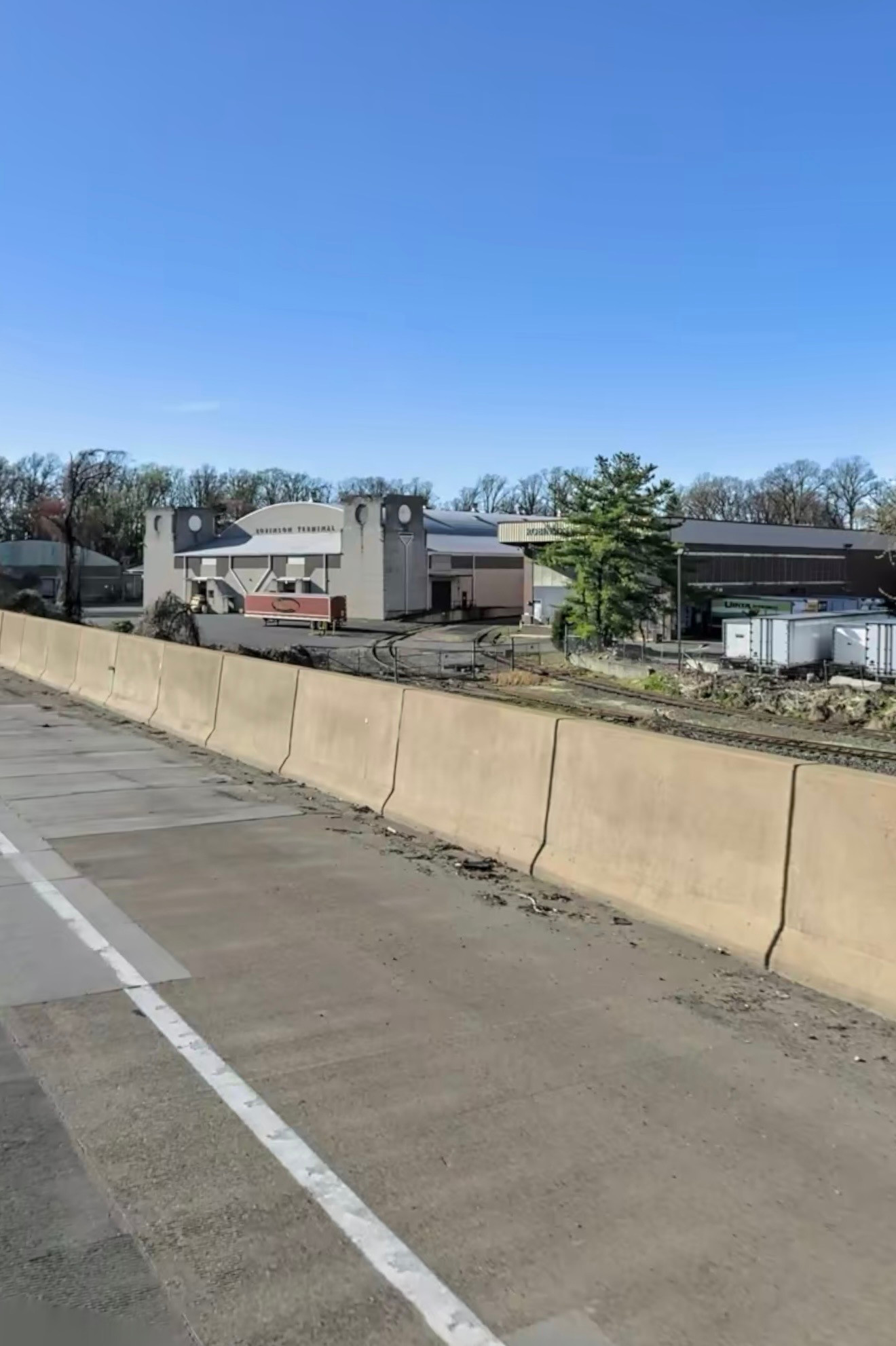
The library photograph below preserves a quieter view of the old roadside identity. Its blank marquee and vegetation are visible evidence; its date is not secure. The catalog’s “circa 1950” label predates the documented opening, so it should not be treated as the date of this scene.
A different kind of gathering place
Mosaic inherited a movie address, not the old experience.
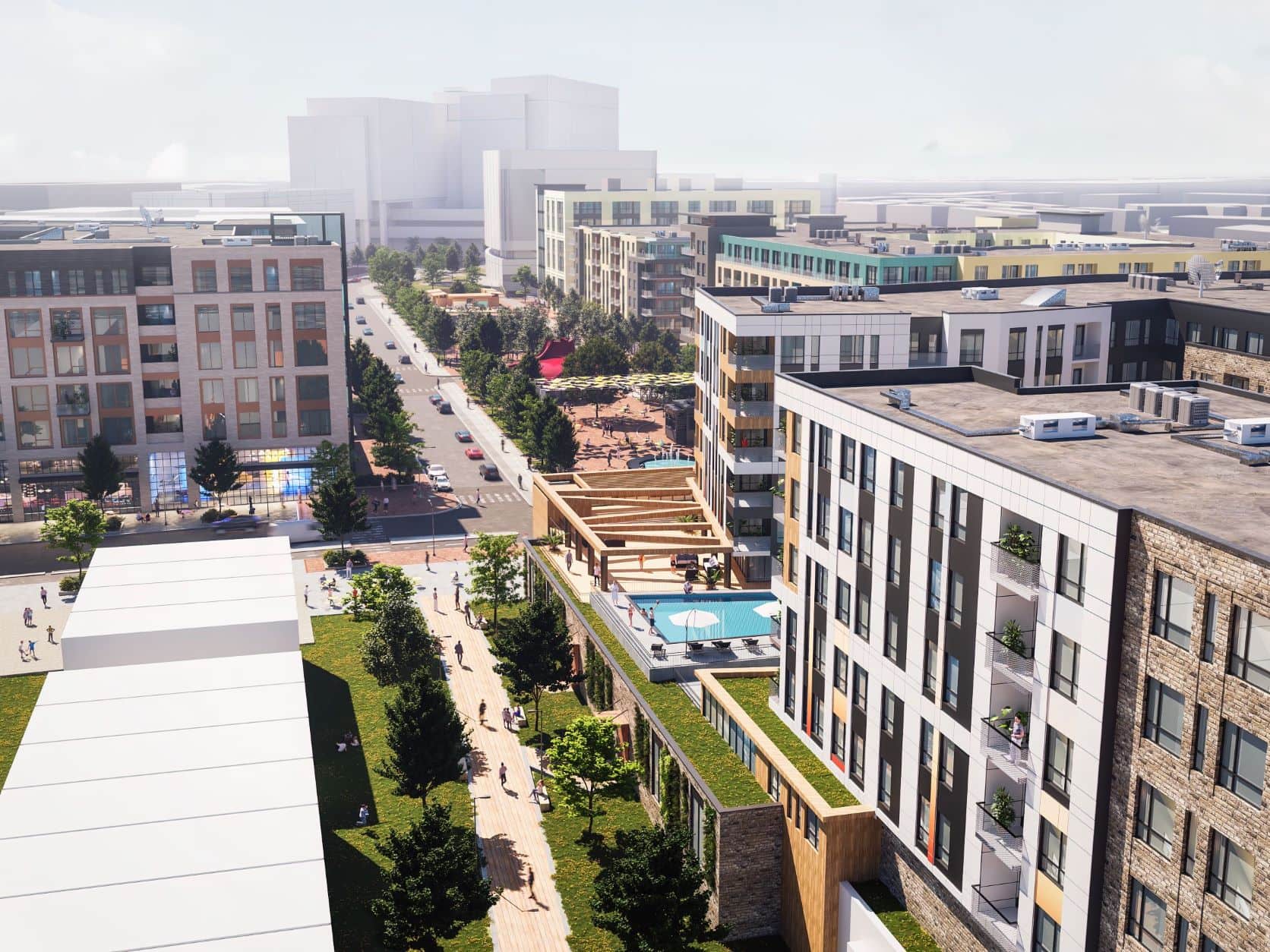
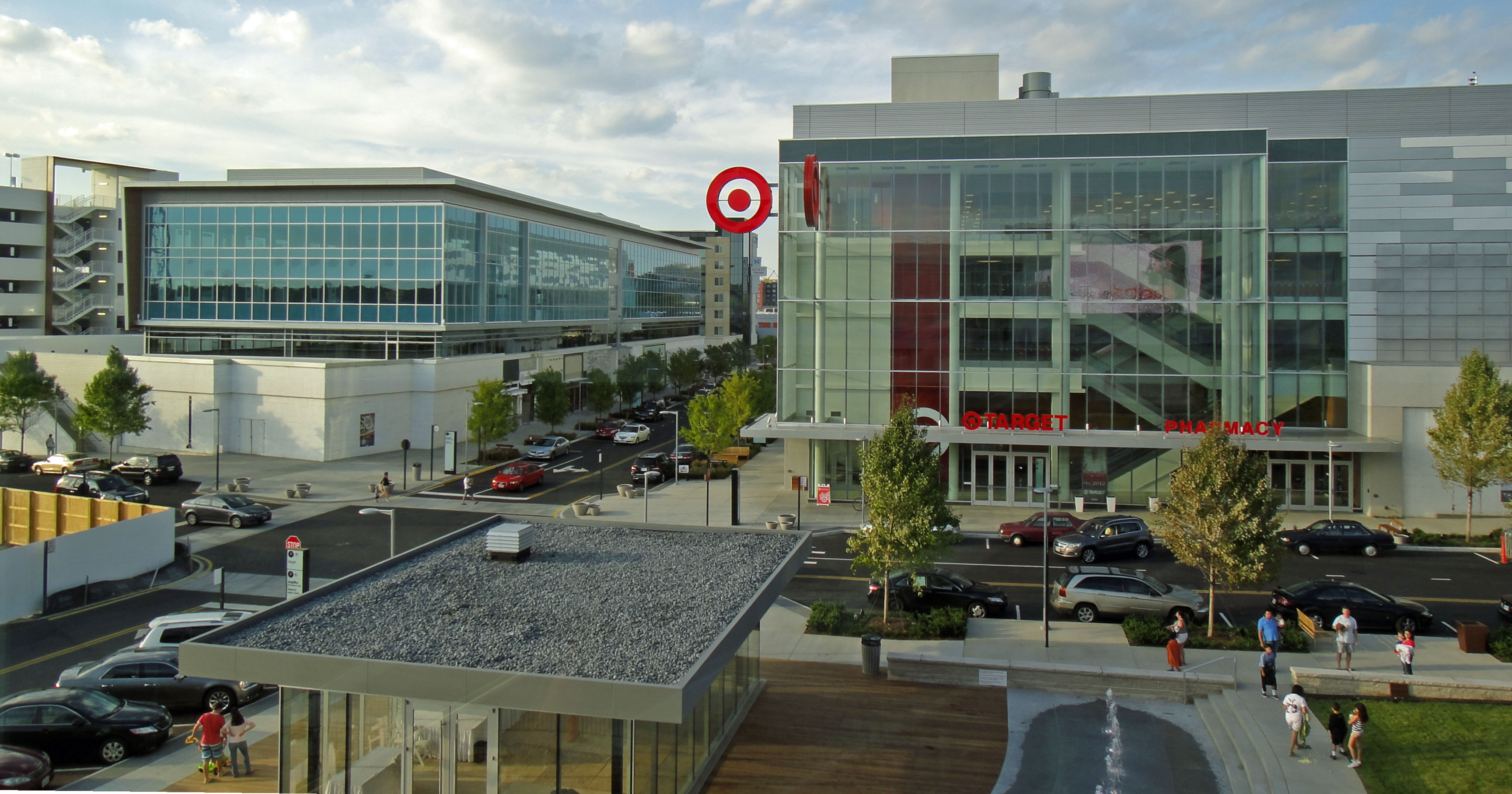
EDENS announced the official opening of Mosaic’s first phase in October 2012, with Angelika among its anchors. Film remained part of the place, but the surrounding evening had changed: storefronts, walking routes and public gathering spaces replaced the old outdoor viewing field.
That continuity is meaningful without pretending the places are interchangeable. A seat at Angelika is not a car beside a speaker. A walk through Mosaic is not a drive down a curved parking row. The same part of Merrifield has hosted several kinds of night out.
The 2012 photograph captures the beginning of that newer chapter, not what the district looks like today. The most interesting before-and-after is not simply buildings replacing asphalt. It is the way people arrived, spent time together and made the place their own.
Your part of the history
What was your movie, and who went with you?
You do not need a perfect date to contribute a useful memory. Start with the movie, the people in the car and one detail you still see clearly. If you remember the indoor multiplex instead, say so. An approximate decade helps put the story in the right chapter.
A ticket, a dated photograph or an old advertisement can anchor a recollection. But the personal detail is often what another reader recognizes: the person who insisted on a particular spot, the trip for food, the way the evening ended.
The old screen is gone. The stories do not have to disappear with it.
Why this matters locally
Places become local history through the ordinary evenings people remember. The Lee Highway Drive-In, the multiplex and Mosaic belong to the same Merrifield story, but each deserves its own photographs, dates and voices.
What movie do you remember seeing at the Lee Highway Drive-In, and who was in the car with you?
Sources and further reading
Where the reporting comes from.
This article draws on public records, official statements, and attributed local reporting. Each link opens the original source.
- Fairfax County Public Library / Braddock Heritage: Lee Highway Drive-In archival photograph and catalog description ↗
- Drive-In Theatres of the Mid-Atlantic: Lee Highway Drive-In history (specialist secondary source) ↗
- Cinema Treasures: Lee Highway Drive-In history (specialist secondary source) ↗
- Cinema Treasures: Lee Highway Multiplex chronology (specialist secondary source) ↗
- EDENS: current Mosaic property description and directory ↗
- Fairfax County GIS: aerial photography collection and historic viewer ↗
- EDENS: October 25, 2012 first-phase opening announcement ↗
- EDENS: summer 2021 Films in the Park program (historical event announcement) ↗
- The Washington Post: January 12, 2006 retrospective (conflicting closure year) ↗
- Payton Chung: Mosaic District photograph, September 18, 2012; CC BY 2.0 ↗
- Creative Commons Attribution 2.0 license for Payton Chung photograph ↗
- Original opening advertisement, preserved by Mike Rivest / Cinema Treasures ↗
- The Washington Post: Movie Memories, January 26, 2006; Carolyn Bounds Botkin’s published recollection ↗
- EDENS / Urban Land Institute: Strawberry Park project history and drive-in-to-Mosaic chronology ↗
- Rob Furey: The Devil at the Drive-In, March 1, 2024; publicly accessible opening of a personal essay ↗