The local story
The possibility of catching an airline flight in Manassas is moving closer to a real terminal. An October airport director’s report says the first phase of terminal-area construction has started, following the airport’s August FAA operating certificate.
The airport is targeting passenger service by the end of 2027. As of October 15, no scheduled passenger airline or route announcement was found in the official sources reviewed. The useful story now is what is being built, what the drawings actually represent and what needs to happen before you can book a flight.
The October update
The terminal project has moved onto the ground
Airport Director Juan Rivera’s October 8 memorandum says Avports has started the first phase of terminal-area construction. The work includes a new terminal building, expansion of the existing parking lot and an economy parking lot. Aircraft have been cleared from the east ramp, and an equipment-storage building is being demolished to make room for the terminal.
The same report says Avports has taken control of the existing terminal and begun paying ground and building rent. Utilities, cleaning and maintenance are now its responsibility. Those are concrete changes in how this part of the airport operates, beyond the renderings and approval milestones.
The memorandum appears in the October 15 commission packet. October 8 is the date of the director’s report, not an independently established groundbreaking date.
October 28 update: the airport held a ceremonial groundbreaking for a separate air traffic control tower on October 20. Its October monthly bulletin, posted October 22, still targets the start of tower construction for spring 2027; the tower announcement anticipates completion by 2029. Those milestones concern the tower, not the passenger-terminal work described above, and do not replace the airport’s end-of-2027 passenger-service target.
Find it on the map
An existing airport off Route 234
Washington Manassas Airport is at 10600 Harry J. Parrish Boulevard in the City of Manassas. The passenger project is a redevelopment within an operating airport. Existing general-aviation activity and the proposed scheduled passenger service are different parts of the story.
This is not a brand-new airfield appearing on vacant land. The airport traces its beginning to a 1932 landing strip near today’s Manaport Shopping Center, then moved to its present location in 1964. The east-side main terminal opened in 1996. The airport currently describes itself as Virginia’s busiest general-aviation airport, with more than 400 based aircraft and more than 100,000 annual aircraft operations. An operation is an aircraft movement, not a passenger count.
General aviation includes flying outside scheduled airline service. For residents, the change is therefore the addition of an airline passenger operation to a place already used by aircraft—not the first arrival of aviation in the neighborhood. Keeping those two baselines separate makes both the travel opportunity and the neighborhood discussion easier to understand.
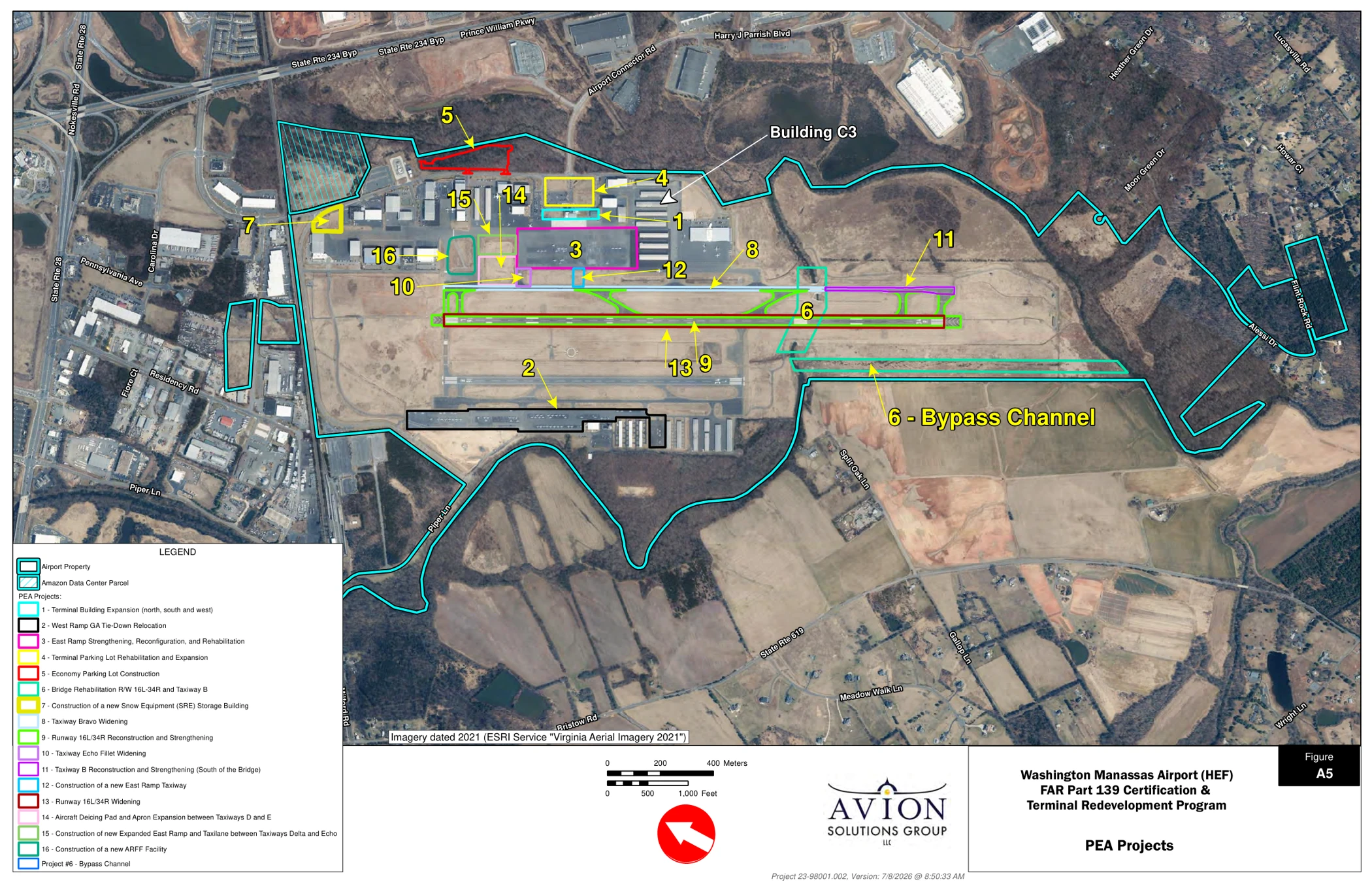
The aerial below helps locate the terminal area and its relationship to the runways, taxiways and access roads. Its base imagery dates to 2021. The colored engineering overlays come from the July 2026 planning exhibit, so this is a locator and planning view rather than a current construction photograph.
Where the terminal fits
What the FAA approved
The certificate clears an important safety hurdle
On August 31, 2026, the FAA granted HEF a Part 139 Airport Operating Certificate. The agency says this allows the airport to accommodate certain commercial passenger airlines. Certification covers standards such as runway and taxiway pavement, emergency planning, aircraft rescue and firefighting, wildlife management and staff training.
The FAA described it as the first new airport operating certificate issued in Virginia in 53 years. An airport certificate establishes a regulatory milestone; a traveler still needs an airline, a published schedule and tickets available for purchase.
Think of the certificate as permission to operate the airport at the required safety standard. It does not fill a departure board. Terminal readiness, the passenger-processing operation and an airline’s commercial decision all have to line up. A carrier chooses where it can attract passengers and operate profitably; certification does not compel it to serve a particular destination.
Read the plan
A larger terminal, built in phases
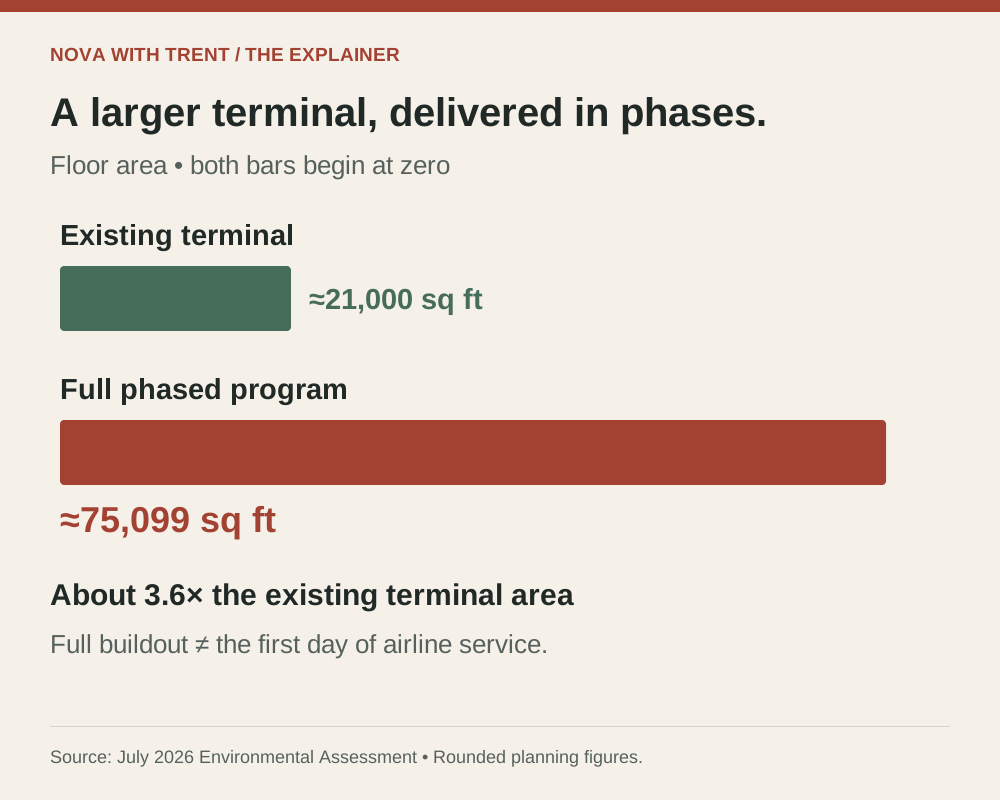
The July 2026 environmental assessment describes a two-phase program taking the terminal from about 21,000 square feet to approximately 75,099 square feet. That is about 3.6 times the existing floor area. The full plan includes seven passenger ground-loading positions, where boarding uses stairs or ramps.
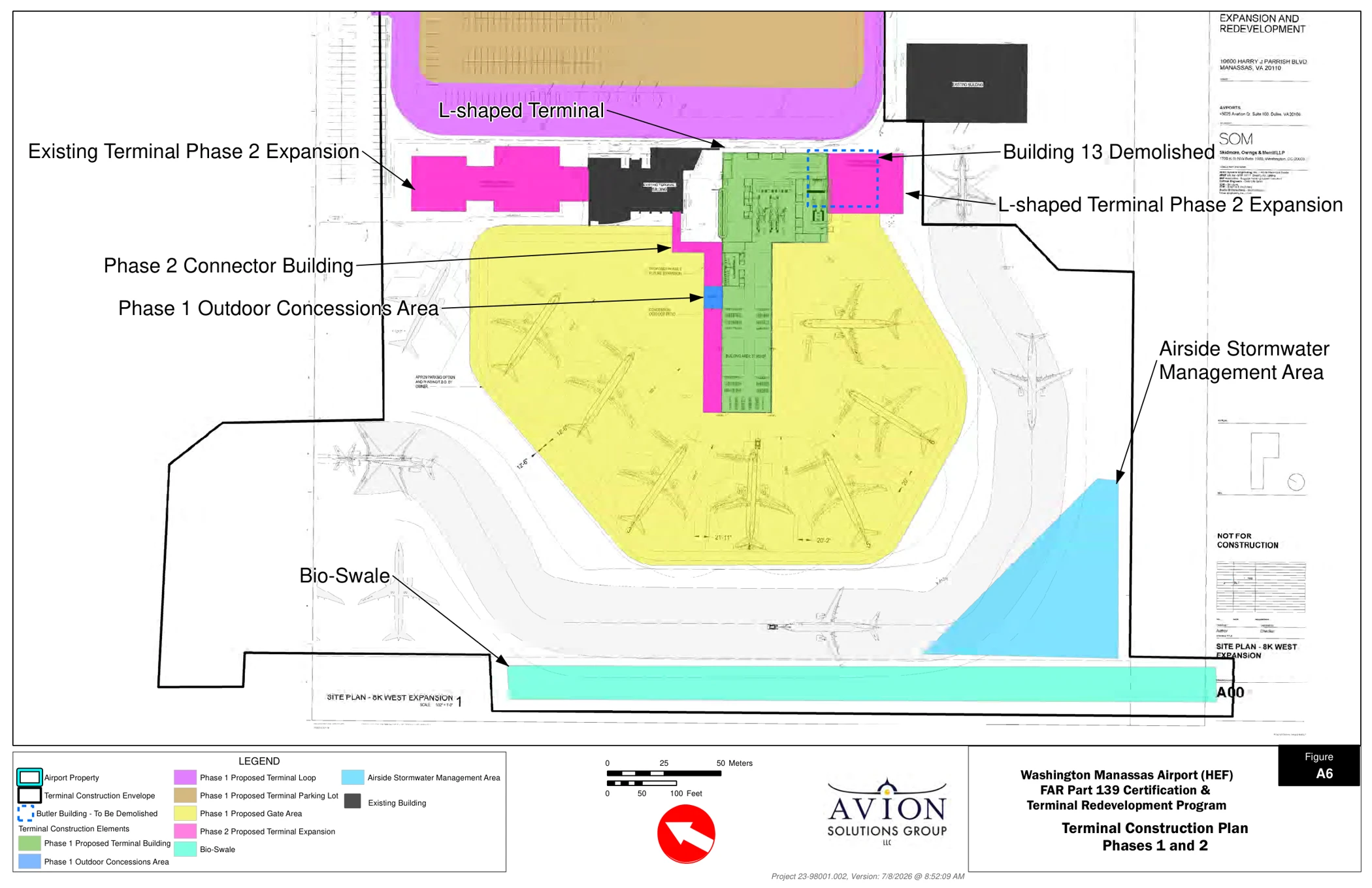
Those are full-buildout figures. They should not be read as a promise that all seven positions or all 75,099 square feet will be ready for the first passenger flight. The phased construction drawing below is the more useful way to understand how the terminal is intended to grow.
The assessment contains planning-era schedule assumptions. For the current passenger-service target, the airport’s later certification announcement is the relevant reference.
The physical sequence matters. The assessment describes a separate first-phase terminal beside the existing building, followed by a connector and extensions in the second phase. That makes the headline floor area a destination for the program, not an opening-day checklist. A construction announcement about the first phase should always be read alongside the phased plan.
The two-phase terminal layout
How much larger is the planned terminal?
Inside the concept
What the passenger spaces could look like
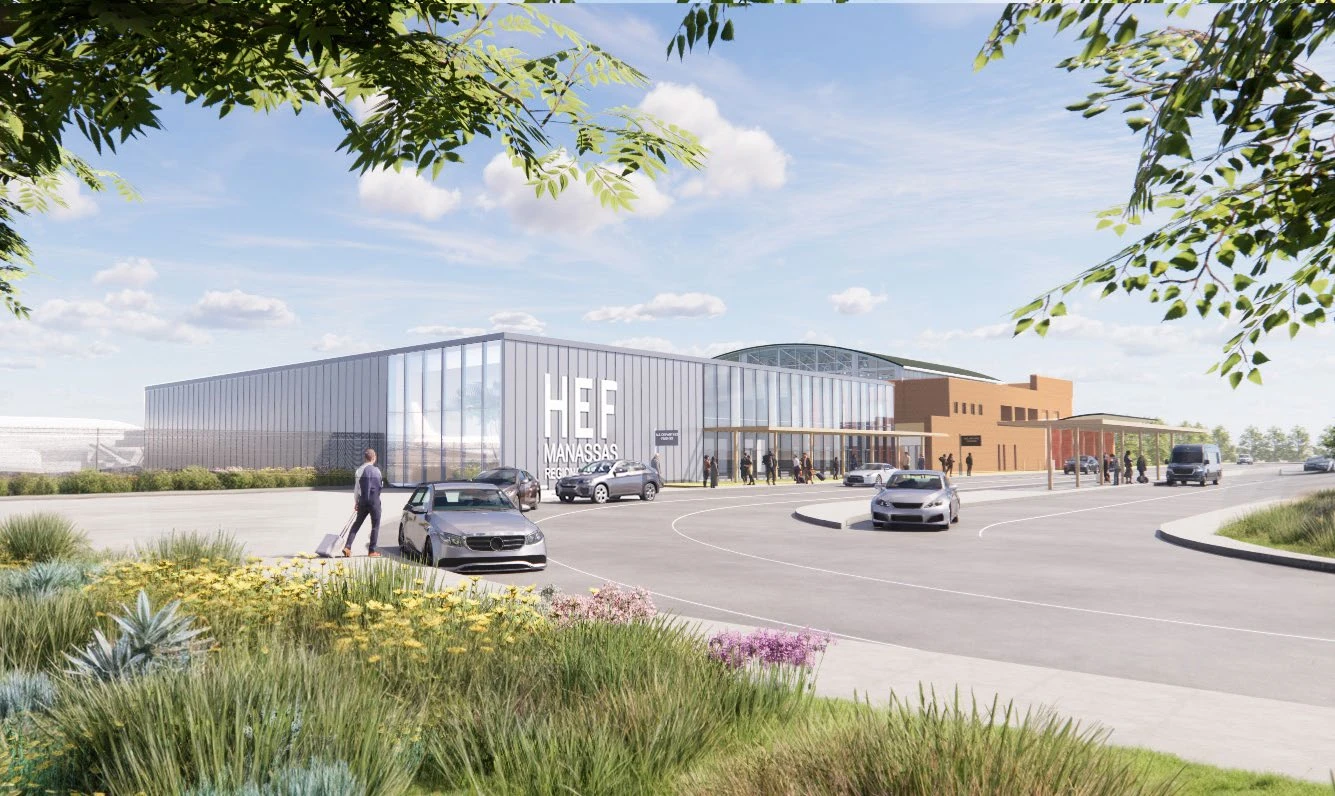
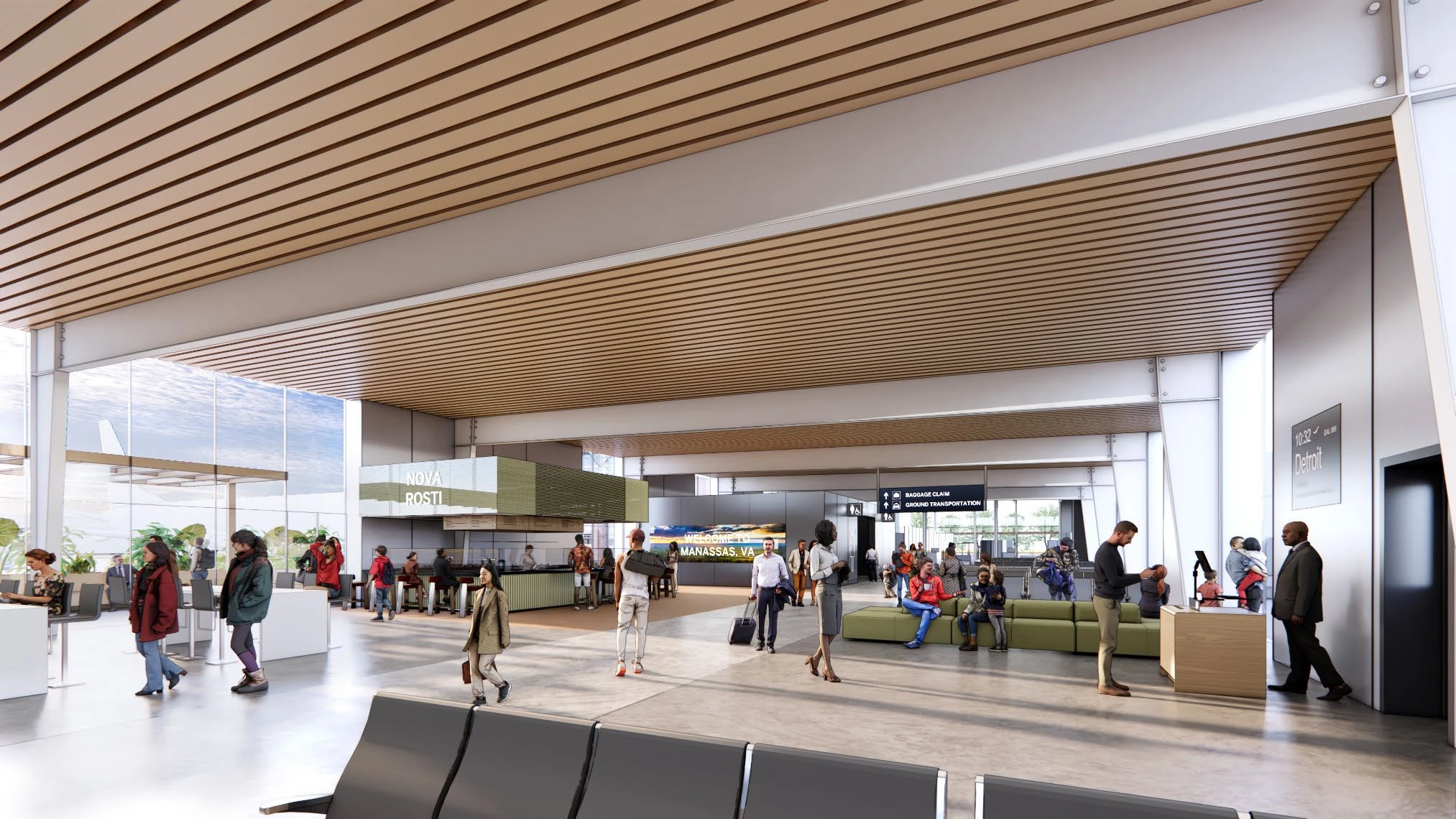
Avports presented these interior concepts to the Airport Commission in March 2025. They show a ticketing lobby and a passenger waiting area with concessions. Together with the exterior view, they give a sense of the intended scale and character of the passenger terminal.
These are preliminary architectural renderings. Any airline names, routes, shops or branding visible in them are illustrative; they do not establish a signed airline or tenant. The final design and business mix may change.
Read the interiors as an explanation of the passenger experience: arrival and check-in, security, waiting near the departure position, then boarding. Arriving passengers need a separate way to reclaim bags and meet their ride. That circulation is why a passenger terminal needs more than a handsome lobby. Useful space means people and luggage can move through it without each step blocking the next.
| Step | What the space does | What to check before traveling |
|---|---|---|
| Check-in / bag drop | Ticketing and baggage acceptance before security. | Airline check-in and bag-drop deadlines. |
| Security screening | Moves departing travelers into the secure passenger area. | Published checkpoint hours and arrival guidance. |
| Waiting / boarding | Holds passengers before they proceed to their aircraft. | Actual gate assignment and boarding method. |
| Arrival / baggage claim | Returns checked bags and connects people to ground transportation. | Pickup arrangements and operating hours. |
The first-phase passenger layout
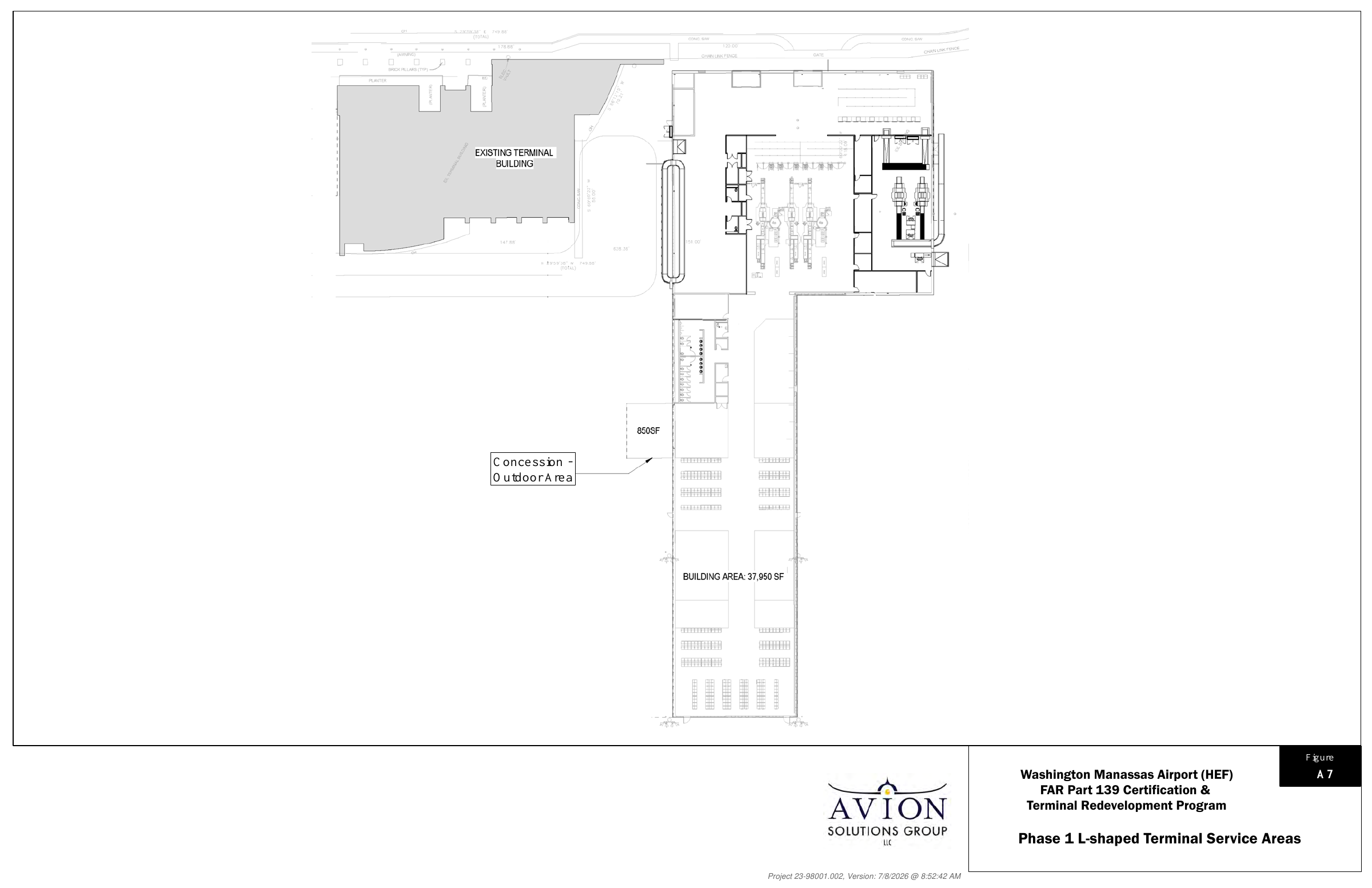
Ticketing lobby concept
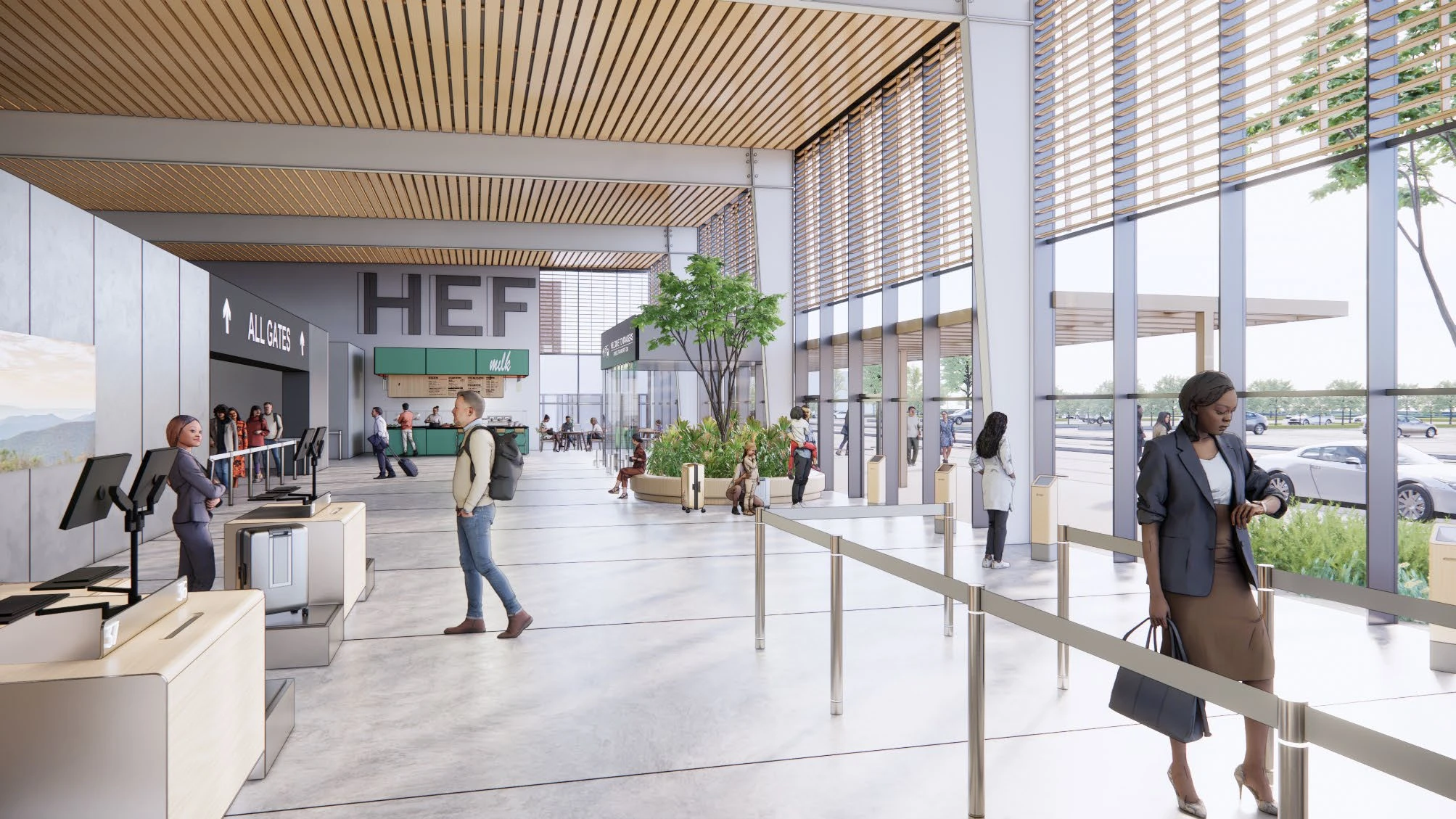
Waiting and concessions concept
Who is doing the work?
Separate the terminal business from the whole airport
The City of Manassas owns and operates the airport. Avports is the company identified in the terminal redevelopment and the October director’s update. Its assumption of the existing terminal, rent payments and responsibility for routine building services help explain the relationship: this is a terminal-area business arrangement inside a city-owned airport. It should not be described as the city selling the entire airport.
There is also a wider infrastructure story. In its August certification announcement, the FAA said it had invested more than $46 million at HEF over the preceding five years, including runway rehabilitation and future air traffic control tower construction. That is an airport-wide investment figure across multiple projects and years. It is not a verified price tag for the new passenger terminal.
For readers following the money, three different numbers would answer three different questions: the terminal construction cost, public spending on airport infrastructure, and payments required under the terminal agreement. Combining them into one dramatic headline would obscure who is paying for what. A final terminal cost or subsidy comparison needs the underlying contracts and capital budget, not an estimate inferred from a rendering.
For airport neighbors
Travel convenience is only half the local story
For nearby households, the relevant questions are practical: when aircraft arrive, which aircraft fly, where they turn, and how the ground traffic reaches the terminal. A busy airport already exists here. The change residents need to assess is the additional pattern of passenger activity, not the airport’s entire existing operation being attributed to a new terminal.
The airport’s voluntary noise program identifies Great Oaks east of the Route 234 Bypass, Moor Green Estates south of the airport and residential areas around Nokesville to the west and southwest as noise-sensitive areas. It encourages considerate flight procedures, while recognizing that pilots and air traffic control retain responsibility for safe operations. Voluntary guidance is not a guarantee that aircraft will never be heard over a neighborhood.
The airport provides a noise complaint form and a 24-hour noise hotline at 703-257-2576. Recording the date, time, location and type of disturbance gives staff something specific to investigate. For a prospective resident, an airport-wide statistic cannot substitute for understanding the actual location of a home and the aircraft activity experienced there.
Long-range passenger forecasts are planning tools. They help size buildings and examine impacts; they are not reservations already made, jobs already created or a published flight schedule. Nor does environmental approval mean every resident will experience no change. The environmental assessment and official noise program are useful starting points for different questions: projected impacts across the project, and how to report a specific event.
Planning a trip?
End of 2027 is the target; routes are still the missing piece
The airport expects commercial passenger service to launch by the end of 2027. That remains a target, not a guaranteed opening day. Our October 15 review of the airport newsroom and Avports news did not identify an announced scheduled passenger airline or route list.
For someone in Manassas or western Prince William County, the potential attraction is straightforward: another place to start a trip. Whether it is actually the better option will depend on the destinations, departure times, fares, baggage charges, parking prices and ground access that become available. Those details cannot be priced or compared responsibly yet.
The next useful announcements will be a named airline and destinations, an operating schedule with a first flight date, and bookable tickets. Until those appear, keep existing travel plans based on airports and flights that are already available.
| Question | Status as of October 15, 2026 |
|---|---|
| Is the airport certified? | Yes: Part 139 certificate issued August 31. |
| Is terminal-area construction underway? | Yes, according to the October 8 director’s report. |
| When is service targeted? | By the end of 2027; subject to delivery and airline readiness. |
| Which airline and destinations? | Not identified in the official announcements reviewed. |
| Can I compare ticket and parking prices? | No verified published package of service, fares and parking prices to compare yet. |
Keep following the project
The next announcement should make the trip real
For now, the airport’s newsroom is the place to check for a formal service announcement, and the plans-and-projects portal leads readers toward the technical material behind the headline. Commission reports are useful for construction progress because they describe operational steps that polished renderings cannot show. The sources below link directly to those official channels.
If an airline is announced, the next question is not simply whether a familiar logo appears. Look for the actual destination airport, travel days, first bookable date and total price for the trip you take. A flight that operates only on certain days may be useful for one traveler and awkward for another. A lower base fare can also be offset by baggage, seat selection or ground transportation.
For Manassas and western Prince William, the potential is a closer starting point for some journeys. The test will be door-to-door usefulness: a destination you need, a schedule you can use and a total cost that makes sense. Until the airport and an airline publish those details, the strongest verified update is that certification is complete and terminal-area construction has begun—not that a particular vacation or business trip is already available to book.
There is now a specific chance to ask about the next steps. The airport’s October bulletin announces a town hall on November 10, 2026 at 6 p.m., at 10678 Aviation Lane in Manassas. Check the airport newsroom before attending in case arrangements change. The bulletin also says an airline-service incentive plan and landing-fee methodology are being developed and will require City Council approval; neither is an airline or route announcement.
Why this matters locally
Passenger service could add a new travel option for western Northern Virginia. Routes, schedules and total trip costs will determine how useful it becomes.
Which destination would make flying from Manassas useful for you?
Sources and further reading
Where the reporting comes from.
This article draws on public records, official statements, and attributed local reporting. Each link opens the original source.
- FAA: Part 139 certificate issued August 31, 2026 ↗
- Washington Manassas Airport: certification and passenger-service target ↗
- Airport director’s October 8 report: October 15, 2026 commission packet, page 10 ↗
- Final Environmental Assessment, July 20, 2026: Table 1-1, PDF page 18 ↗
- Official aerial and phased terminal plan: July 8, 2026, Figures A5–A6 ↗
- Avports preliminary terminal concepts: March 20, 2025 commission packet, pages 48–50 ↗
- Washington Manassas Airport newsroom: checked October 15, 2026 ↗
- Avports news: checked October 15, 2026 ↗
- Airport history, existing aviation activity and public observation area ↗
- Official noise program, neighborhood guidance and complaint form ↗
- Official plans and projects portal ↗
- Washington Manassas Airport: October 20, 2026 ceremonial control-tower groundbreaking and 2029 target ↗
- Washington Manassas Airport: October 2026 monthly bulletin, posted October 22; tower schedule and November 10 town hall ↗